
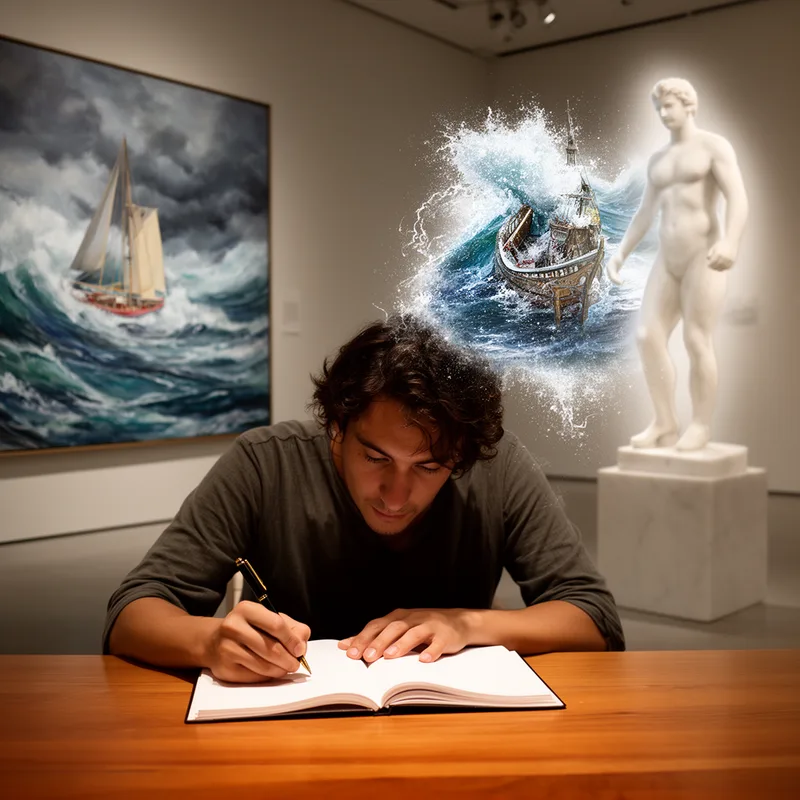
ekphrastic
 1
9.9

- adjective
- /ɛkˈfræstɪk/
- Literature
- For instance, the article by Gonse that I quoted above demonstrates the possibilities of an ekphrastic mode that does not eschew historical criticism and that welcomes the partnership of the contemporary visual artist in renewing our perceptions of the art of the past.
Examples
-
A series of her paintings, accompanied by ekphrastic poems, is currently on exhibit at Nokia Art House, Tampere, Finland through April 2013.
Blog text (2) -
In Sight and Song, the Fields link ekphrastic form with themes of mourning.
Academic text (2017) -
And they understand that those bodies present special obstacles and opportunities for the ekphrastic representations they would attempt in Sight and Song.
Academic text (2017) -
As Mitchell writes, the basic project of this "ekphrastic hope" is "the transformation of the dead, passive image into a living creature."
Academic text (2017) -
Much of the critical work on Sight and Song has focused on the gaze and the way in which Field's ekphrastic poetry mediates that gaze.
Academic text (2016) -
They were preparing to compose their ekphrastic volume, Sight and Song, which would "translate," as they put it, selected European paintings into poetry.
Academic text (2017) -
In certain instances, an ekphrastic passage or phrase appears to spark his imagination, evoking vivid imagery.
Academic text (1996) -
It is as if they acknowledge the impossibility of the ekphrastic task at the same time that they quixotically assert the worthiness of the endeavor.
Academic text (2017) -
Michael Field thus anticipates the theme of the banality of tragedy in Auden's famous ekphrastic poem "Musée des Beaux Arts."
Academic text (2017) -
The poet's latest work is an ekphrastic tribute to the beauty of Van Gogh's paintings, vividly bringing the artwork to life with descriptive language.
Synonyms
 2
9.9
Having very clear and detailed pictures in the mind like a photograph
 1
7.9
A style that uses clear, vivid images in writing or art
 1
8.0
Shows clear, vivid pictures in writing or art

Having many rich decorative details that look complex
How Vivid

Surface Forms
Morphology
Etymology
Ekphrastic comes from Greek parts ek- 'out' and phrasis 'speech', and it shares the same root as phrase. That original idea of 'speaking out' helps: ekphrastic writing 'speaks out' a painting or sculpture, giving a clear description of the work of art.