
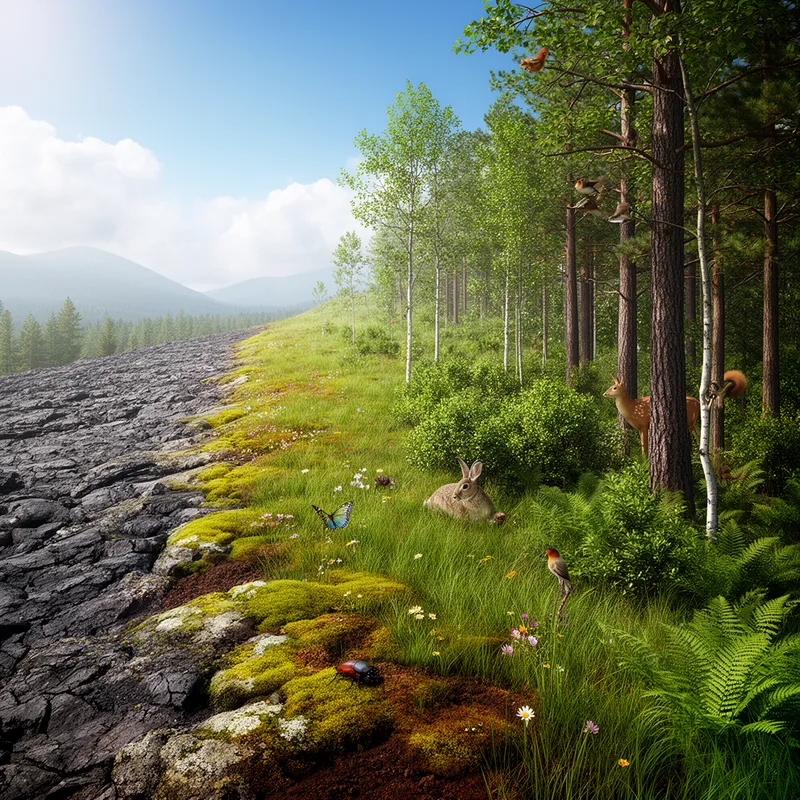
ecological succession
- noun
- /ˌiːkəˈlɒdʒɪkəl səkˈsɛʃən/
- Specialized
- The process of ecological succession can be observed when a barren field transforms into a lush forest over time.
- ecological succession stages
Examples
-
If the cleared plot is abandoned after three or four planting seasons, the forest regenerates through processes of ecological succession.
Academic text (1998) -
Gleason (1926) developed his ideas about ecological succession as an alternative to those of Clements, which were far more prominent in the early twentieth century.
Academic text (2013) -
We have also shown that annual C storage changes over ecological succession, as hypothesized by ecologists decades ago.
Academic text (2008) -
This will help us better understand the ecological succession of termite infestations.
Academic text (2003) -
Annual carbon storage varies through ecological succession by rising to a maximum and then slowly declining in old-growth stands.
Academic text (2008) -
How will changes in climate and disturbance regimes, together with continued ecological succession, constrain future forest C storage in the upper Midwest?
Academic text (2008) -
A forest's position along the trajectory of ecological succession is an important determinant of C storage potential (Magnani et al. 2007).
Academic text (2008) -
Regional appraisals of terrestrial C storage require quantitative knowledge of how annual C storage changes through ecological succession because most landscapes encompass forest stands of varying ages (Chen et al. 2004).
Academic text (2008) -
Ecological succession often begins with the colonization of pioneer species, which prepare the habitat for larger plants.
-
During ecological succession, each stage of community development leads to increased biodiversity and habitat stability.
Synonyms

 4
7.4
4
7.4

The slow change in plants and animals in an area over time
How Advanced
- Specialized

- Specialized
Surface Forms
Morphology
The phrase is fully compositional: 'ecological' restricts 'succession' to ecological contexts and 'succession' denotes an orderly, staged replacement or sequence, so the overall meaning 'gradual, orderly change in an ecosystem' is directly derivable from the parts. This logic is cross-linguistically common (e.g., Spanish 'sucesión ecológica', French 'succession écologique'), so a B1 learner who knows both constituents would likely understand the MWE.
Etymology
Ecological succession uses ecological (about living things) and succession (meaning 'one thing after another'). Imagine a bare field where grasses grow first, then shrubs, then trees, each replacing the last, so ecological succession means this step-by-step replacement of life in an area.