
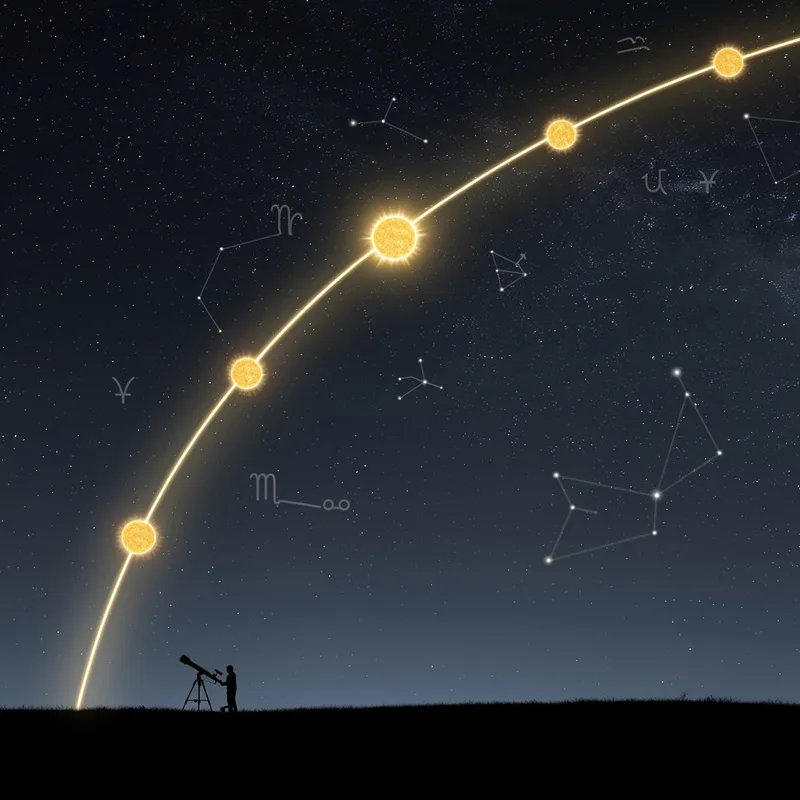
ecliptic
 2
9.9

- noun
- /ɪˈklɪptɪk/
- Specialized
- Watching sunrise and sunset times during a year makes the ecliptic readily apparent.
- plane of the ecliptic
Loading YouTube…
Watch on YouTubeBut he didn't understand why the solar system was all in a plane, what we call the ecliptic.
- But he didn't understand why the solar system was all in a plane, what we call the ecliptic.
Examples
-
On that day, the winter solstice sun conjuncts the crossing point of the galactic equator and the ecliptic.
Academic text (2000) -
The reference plane, or ecliptic, is defined by Earth's orbit around the Sun.
Academic text (2004) -
It's well within the plane of the ecliptic.
-
"It's in the inner system, and near the plane of the ecliptic.
Fiction book (1999) -
Wheelchair visitors can view at least some parts of the sky, including much of the ecliptic.
Academic text (2003) -
Its shape is still traced out by the ecliptic, the plane in which the planets' orbits lie.
Academic text (1992) -
Their spacecraft is already zooming out of the solar system, heading high above the ecliptic.
Fiction book (1998) -
Venus's orbit is tilted by 3.5 degrees to the ecliptic.
Academic text (2004) -
Jupiter currently plies the ecliptic in Ophiuchus, near the southernmost point in the planet's 12-year journey around the Sun.
Academic text (2007) -
The reference plane, or ecliptic, is defined by Earth's orbit around the Sun.
Synonyms
 1
7.9
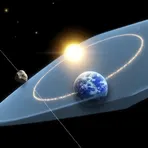
A flat path in space that a thing follows as it goes around a planet or star
Surface Forms
Morphology
ecliptic = eclipse (opaque) = eclipt + ic
Although historically related to 'eclipse', the meaning 'the sun's apparent path/plane' is not directly derivable from 'eclipse' and the form shows an irregular change (s → t).
Etymology
Ecliptic comes from the same root as eclipse, a word from Greek that meant 'to leave' or 'be absent' because an eclipse makes the sun or moon seem to disappear. That's why the ecliptic is the sun's path in the sky: it is the place where eclipses can happen.