

early coral root
- noun
- /ˈɜrli ˈkɔrəl ruːt/
- Specialized
- Because early coral root lacks true leaves, it often goes unnoticed among the undergrowth.
Examples
-
The botanist collected samples of early coral root for her research on native orchids.
-
The early coral root blooms in the spring.
-
We spotted an early coral root blooming in the shadowy forest near the river.
-
I spotted an early coral root near the trail.
-
The botanist studied the early coral root to understand its unique growth patterns in the forest.
-
While hiking, we discovered an early coral root hidden among the fallen leaves near the creek.
-
In springtime, the early coral root produces delicate blossoms that add beauty to the forest floor.
Synonyms

A small orchid with almost no leaves and pale yellow-green stems and flowers
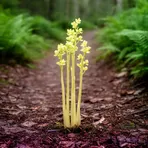
A plant with almost no leaves and pale yellow-green stems and flowers
Surface Forms
Morphology
The noun phrase is compositionally built from 'early' (timing) + 'coral' (a descriptive element, likely colour or resemblance) + 'root' (plant organ), so a learner who knows the words can infer it denotes a kind of plant that appears early or has a coral-related quality. However, the precise botanical sense (a specific nearly leafless North American orchid) and the intended sense of 'coral' are not fully predictable from the parts alone, so full understanding would likely require prior exposure.
Etymology
Early coral root is a name that creates a clear picture: early because the orchid flowers near the start of the season, and coral and root because its pale, branching underground parts look like small pieces of coral instead of green leaves. So the name helps you remember this almost leafless orchid that appears 'early' with coral-like roots.

