
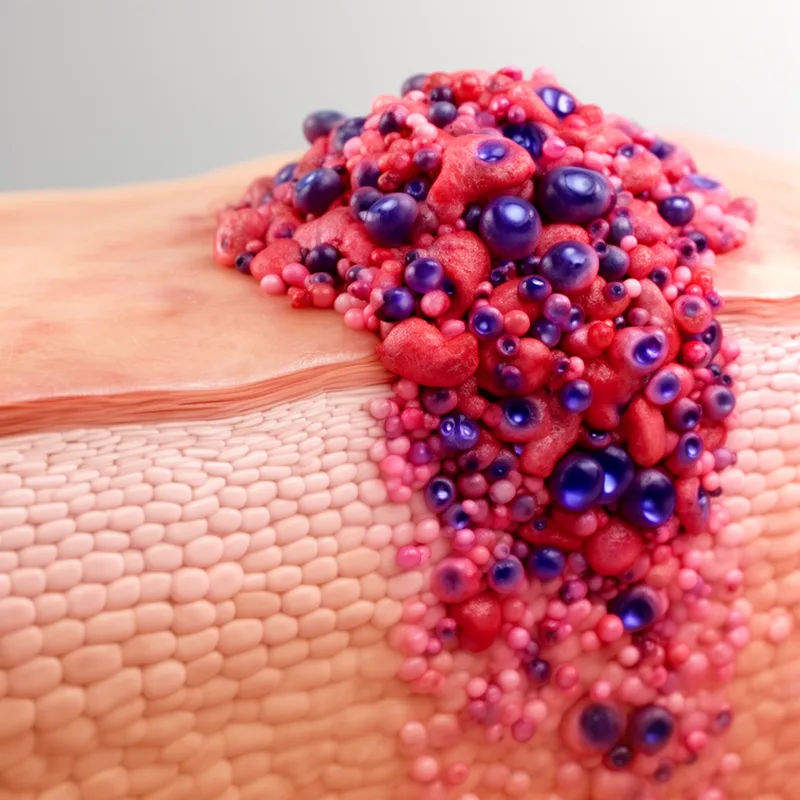
dysplastic


 1
9.9
1
9.9
- adjective
- /dɪsˈplæstɪk/
- Specialized
- The doctor explained that the biopsy revealed dysplastic cells, indicating a risk of developing cancer.
- dysplastic mucosa
Examples
-
The overlying epidermis revealed a typical Bowen's disease with dysplastic keratinocytes occupying the entire thickness of the epidermis (Figure 5).
Academic text (2007) -
Dysplastic bone can compress the optic nerve, which can lead to blindness.
Academic text (2008) -
No dysplastic epithelium was identified.
Academic text (2007) -
You have a severely dysplastic compound, Nevis.
-
In this study, we observed p53 overexpression in normal-looking or dysplastic mucosa in four cases.
Academic text (1995) -
On microscopic examination, the tumor mass was composed of large dysplastic epithelioid and spindle cells forming nests and sheets.
Academic text (2007) -
Head and neck squamous cell carcinoma (HNSCC) has been shown to progress through a series of dysplastic histopathologic changes before it becomes an invasive cancer.
Academic text (2003) -
The mucoepidermoid carcinomas in their series were frequently accompanied by abnormal (dysplastic) surface mucosa adjacent to the tumor.
Academic text (2002) -
As emphasized by some authors, we believe that observation of p53 overexpression in otherwise normal or dysplastic mucosa suggests the early involvement of the p53 gene in carcinogenesis.
Academic text (1995) -
In 26 of the 51 cases, there was non-neoplastic mucosa on the same slide, and in four of these sections, p53 staining was observed in dysplastic or "normal-looking" epithelium (Figure 2).
Academic text (1995)
Antonyms

How Abnormal
19
4.3

- Specialized
2
5.8
- Specialized
1
9.9
27
5.7
∞
1.0
Surface Forms
Morphology
Etymology
The word dysplastic has two parts: the first part dys- means 'bad' or 'difficult', and the second part -plastic comes from a Greek root meaning 'to form' or 'to shape', like plastic the material that can be shaped. So, dysplastic describes cells or tissue that are 'badly formed' or growing the wrong way.