
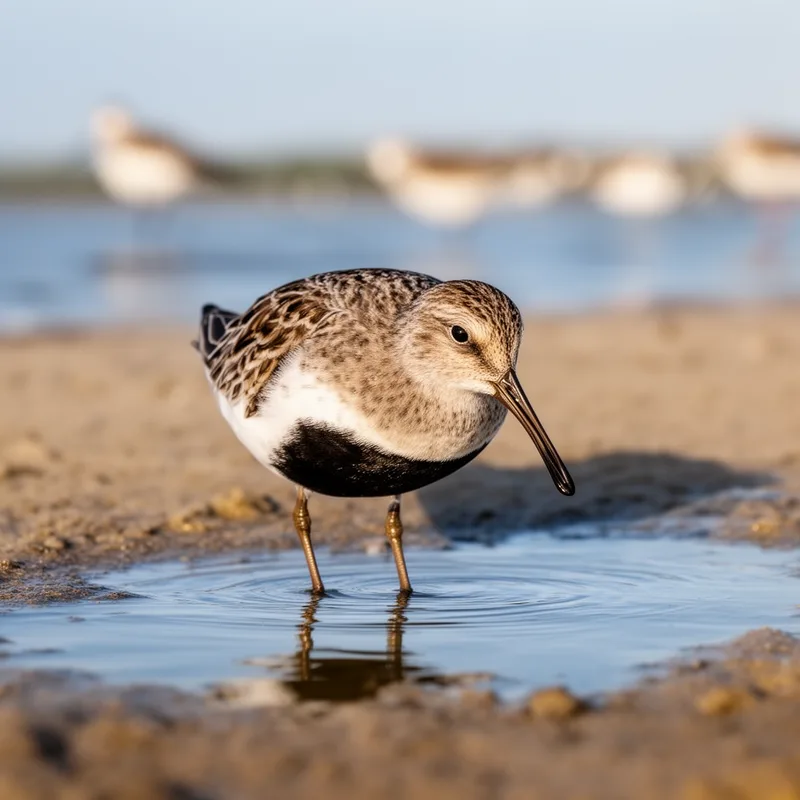
dunlin


 1
9.9
1
9.9
- noun
- /ˈdʌn.lɪn/
- Specialized
- The dunlin is easily recognized by its small size and distinctive black belly patch during breeding season.
- dunlin and sandpipers
- dunlin and plovers
Examples
-
Her father had taught her some of their names: eiders, dunlins, longspurs, phalaropes, golden plovers.
Fiction book (2000) -
Distant flock of shorebirds (likely more Dunlin).
Blog text (34) -
Before long, they were right overhead, and I could clearly see that these 30-40 birds were shorebirds, Dunlin, in fact.
Blog text (34) -
For the next hour or so, several flocks of presumed Dunlin passed overhead or along the major ridge.
Blog text (34) -
Flock of Dunlin
Blog text (34) -
A fling of dunlins
Blog text (7) -
As a result of this distance, "shorebird sp." is the best identification I could make of these distant specks, although it is very likely that these were more Dunlin.
Blog text (34) -
While walking along the beach, I spotted a group of dunlin foraging for food in the wet sand.
-
During migration, dunlin can often be seen flying in large flocks along the coastline.
Synonyms
A small wading bird with a red back that breeds in the Arctic and flies south in winter

A small sandpiper that breeds in Arctic regions and winters on warmer coasts
Surface Forms
Morphology
Etymology
The word dunlin comes from old Scots or northern English: dun meaning 'brown' and the little ending -ling meaning 'small one'. Think of it like duckling but with 'dun' for colour, so it literally means a 'small brown one', which fits this small wading bird.