
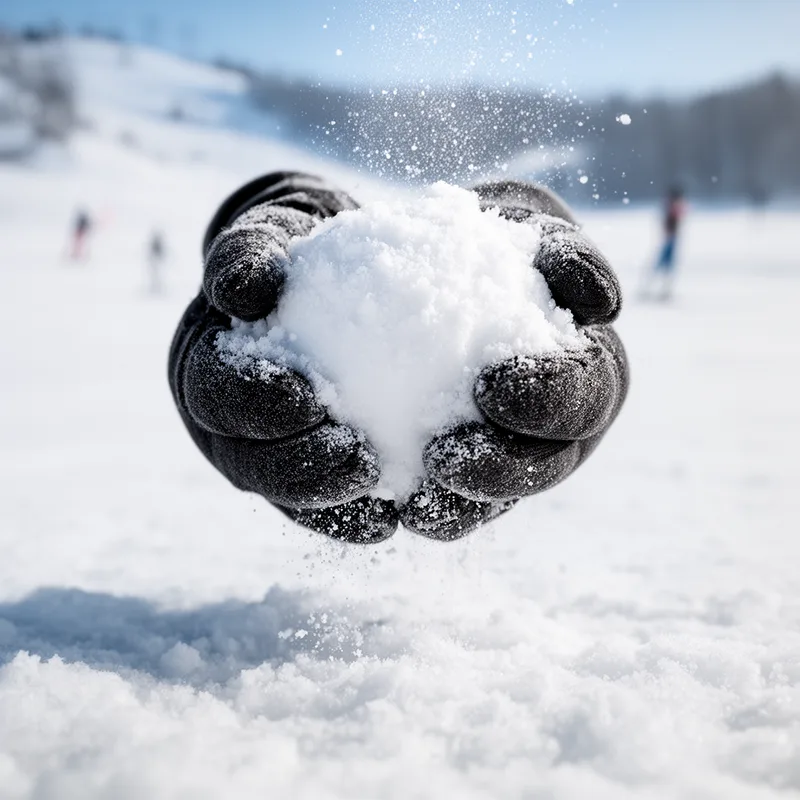
dry snow


 1
2.8
1
2.8
- noun
- UK
- There was crisp, dry snow under his feet and more snow lying on the branches of the trees.
Examples
-
He stepped off the path; the dry snow crunched under his boots. He hastened; he was directly behind her.
Fiction book (2000) -
Dry snow is difficult to measure because its surface is highly sound-absorbent when it first falls.
Academic text (1994) -
Most commented that the snow was wetter, unlike the dry snow of twenty years previously.
Academic text (2007) -
The wind blew through the starlit darkness, and before dawn brought with it a fall of thick, dry snow that quickly covered the valley.
Fiction book (1992) -
Flashiness is further influenced by the water storage capacity of the snow, which is a function of temperature (Swanson et al. 1998): Warm and wet snow layers melt more quickly, whereas cold and dry snow stores rainwater in the early phase of a rain-on-snow event, attenuating the rise in discharge.
Academic text (2013) -
The mountain had a beautiful layer of dry snow that sparkled in the sunlight.
-
After a recent storm, we enjoyed skiing on light, fluffy dry snow that wasn't sticky at all.
-
The weather report mentioned that we could expect a fresh coating of dry snow overnight, perfect for winter sports.
Synonyms
 ∞
1.0
∞
1.0
Frozen water that falls as white flakes and covers the ground
How Wet
- UK
26
1.4

- UK
1
2.8
Surface Forms
Morphology
The meaning 'snow with very little or no liquid water' is directly derivable from combining 'dry' (not wet) with 'snow' (frozen flakes). This straightforward adjective+noun composition is compositional and cross-linguistically common, so a B1 learner who knows both constituents will readily infer the MWE's meaning.
Etymology
Dry snow means snow that has almost no water. The word dry shows this lack and snow is the frozen flakes, so the snow is 'not sticky' and 'powdery', does not hold together for snowballs, and is the kind many skiers prefer.