

dry mop
- noun
- The janitor reached for the dry mop instead of the wet one.
Examples
-
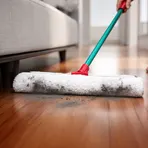
Every classroom is cleaned daily with a dry mop to keep it free of dust.
-
She used a dry mop to quickly remove the dust from the hallway floor.
-
She used a dry mop to clean the dusty floor.
-
The dry mop is perfect for quick clean-ups.
-
To remove the dust from the hardwood floor, she used a dry mop instead of a damp one.
-
The janitor quickly moved through the hallway, using a dry mop to clean up the mess.
-
Every evening, he would take a dry mop to ensure the floors were spotless before closing time.
Synonyms




Surface Forms
Morphology
The compound simply combines the adjective 'dry' (not wet) with 'mop' (cleaning tool) to denote a mop that is dry or used without water; the meaning is directly derivable from the constituents. This compositional adjective + noun pattern is common and cross-linguistically regular, so a B1 learner who knows both words would readily understand it.
Etymology
Dry mop comes from the simple picture of a dry head on a mop that sweeps up dust and dirt instead of using water. So it means 'a mop used for dusting' or cleaning floors 'without water'.