

dress suit


 1
3.5
1
3.5
- noun
- /drɛs suːt/
- For the wedding, he decided to buy a new dress suit to look his best.
Examples
-
Why two dress suits and a white dinner jacket as well, whereas the shirts were so worn they were not worth giving away, and there seemed to be only three pairs of misshapen shoes?
Fiction book (1994) -
The night was warm; the other young men in the full-dress suits must feel rather sticky, he thought.
Fiction book (1992) -
-Is this your new dress suit?
-
You wore your first full dress suit.
-
He had on a dress suit and patent leather shoes.
-
The woman was sharply dressed, with a dark blue dress suit, hat, sunglasses, and an attaché case.
Fiction book (1998) -
She wore a navy blue dress suit with a modest skirt, white button-down blouse, heels, and stockings.
Blog text (3) -
I'm having a hard time believing that these Russian kids—all of them!—would voluntarily wear dress suits to school.
Blog text (5) -
At the gala, many men wore a classic dress suit complemented by a bow tie.
-
He felt proud as he put on his late father's dress suit for the formal event.
Synonyms
 2
8.2
2
8.2
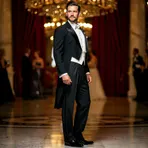
A very formal men's suit with a coat that has a long back worn at special events
 1
6.8
1
6.8
Formal evening clothes for men worn at very important events
 1
8.1
1
8.1
A very formal evening outfit for men with a white bow tie, white waistcoat, black tailcoat, and matching trousers
How Formal

Surface Forms
Morphology
The meaning 'a formal outfit' is directly and predictably derived from combining 'dress' (formal) with 'suit' (matching jacket and trousers), so a learner who knows both constituents can infer this refers to a formal suit. The modifier+noun compositional pattern is common in English and cross-linguistically familiar, making the expression immediately comprehensible to B1 learners.
Etymology
Dress suit comes from the idea of a special suit for 'dress' occasions. In older English dress meant very formal clothes for the evening, like a tailcoat, white shirt and bow tie, so dress suit means a man's formal outfit for evening events.