
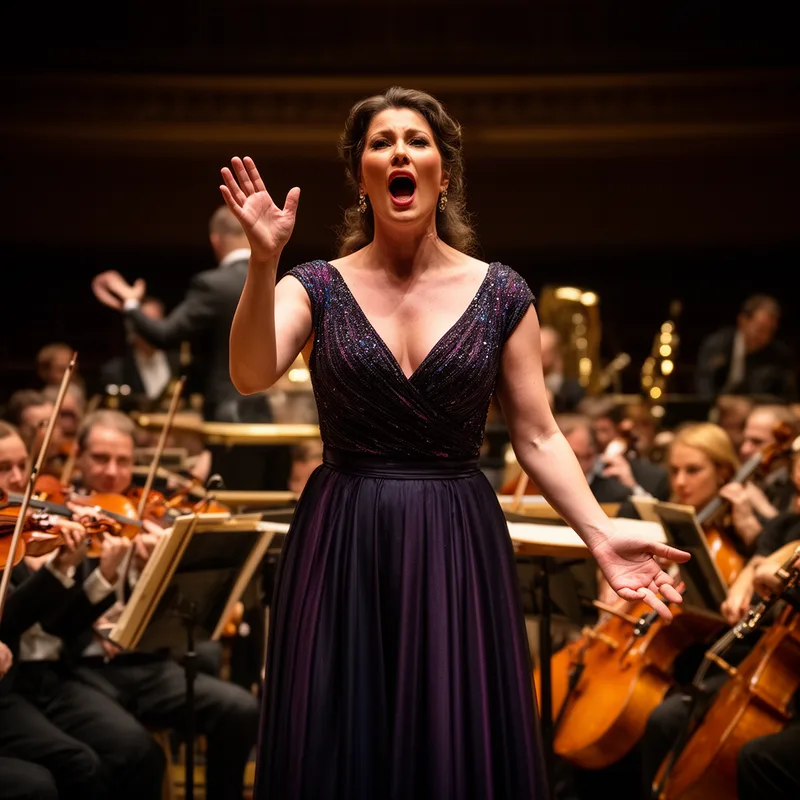
dramatic mezzo-soprano
- noun
- /drəˈmætɪk ˌmɛtsoʊ səˈprɑːnoʊ/
- Specialized
- She trained for years to develop into a true dramatic mezzo-soprano capable of performing challenging roles.
Examples
-
The role requires a dramatic mezzo-soprano with a powerful voice and commanding stage presence.
-
She is a talented dramatic mezzo-soprano.
-
Many Verdi operas feature parts written for a dramatic mezzo-soprano, demanding both strength and subtlety.
-
The opera featured a stunning dramatic mezzo-soprano.
-
The opera featured a dramatic mezzo-soprano whose powerful voice captivated the audience throughout the performance.
-
During the competition, the judges were impressed by the dramatic mezzo-soprano who effortlessly hit high notes despite the orchestra's volume.
-
Her career took off after she was recognized as a talented dramatic mezzo-soprano with remarkable vocal control and expressiveness.
Synonyms

 4
8.0
4
8.0

A female singing voice between soprano and contralto
 2
6.9
2
6.9
A woman singer with a voice higher than a low voice but lower than a very high voice
How Powerful
- Specialized

- Specialized
- Specialized
- Specialized
Surface Forms
Morphology
dramatic + mezzo-soprano
This is a straightforward adjective+noun composition: a 'dramatic' (powerful, expressive) type of 'mezzo-soprano' (a female voice type), so the subtype meaning is directly derivable from the constituents. The modifier+head pattern is regular and cross-linguistically common, making the phrase transparent to a B1 learner who knows both words.
Etymology
Dramatic mezzo-soprano comes from opera language: it joins mezzo ('middle') and soprano ('high voice'), and dramatic means a strong, powerful way of singing for the stage. So it describes a female singer with a middle-range voice that is rich and loud enough for big, emotional roles.