
divisive policy


 1
6.3
1
6.3
- noun
- /dɪˈvaɪsɪv ˈpɑlɪsi/
- Fox News has already been finding everyone they can to go on the air and start spouting about how they lost because they obviously were not "conservative" enough, and that it was entirely Obama's divisive policies that drove the election.
Examples
-
Such an approach, of course, Kater places in sharp contrast to the divisive policies of the Christian Right.
Academic text (1991) -
Yet the fruits of the divisive policy still exist—nine languages are spoken in South Africa.
Academic text (1991) -
While opposing both independence and early reunification, it denounced the DPP for its violent orientation and divisive policy and condemned the NP as a "trouble-maker" and the "spokesman" of mainland China.
Academic text (1996) -
The government's new divisive policy on immigration sparked protests across the country.
-
Many citizens believe that the divisive policy regarding education funding will widen the gap between rich and poor communities.
-
Critics argue that the divisive policy on healthcare has led to increased tension among different social groups.
Antonyms

Surface Forms
Morphology
The meaning 'a policy that causes disagreement or conflict' is directly and transparently derived from combining 'divisive' (creating division or disagreement) with 'policy' (a plan or guiding principle). This is a straightforward adjective+noun composition following ordinary semantic combination patterns, so a B1 learner who knows both constituents would readily infer the MWE meaning.
Etymology
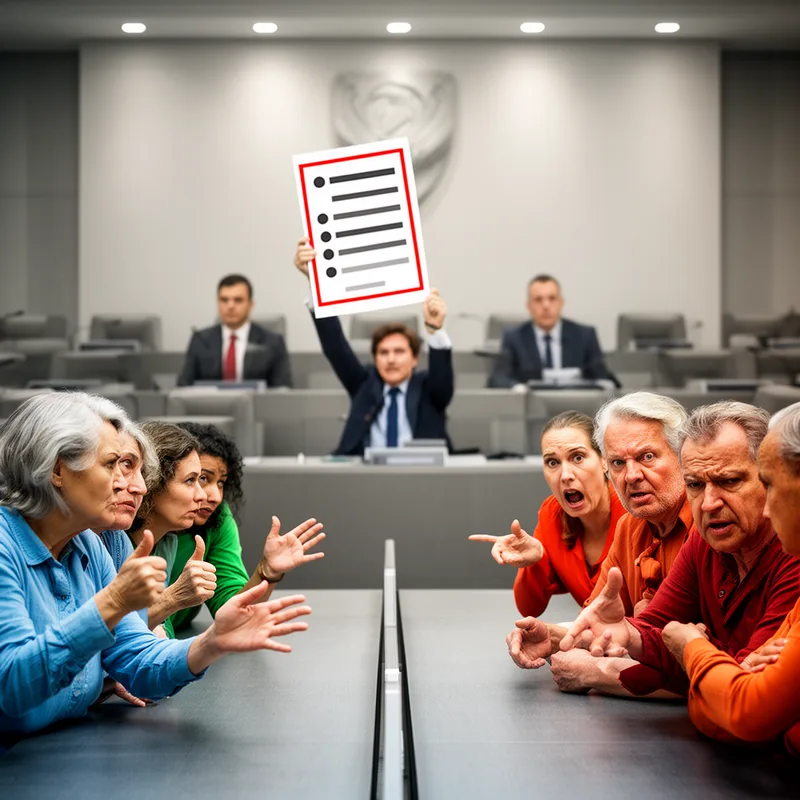
The phrase divisive policy comes from the image of a rule that divides people into opposing sides. Divisive means causing a split and policy means a rule or plan, so a divisive policy is one that makes people disagree or 'take different sides'.