

displaced person
 10
5.3
10
5.3

- noun
- /dɪsˈpleɪst ˈpɜrsən/
- At this moment, there are more displaced people in the world than at any time in history.
- internally displaced persons
- refugees and displaced persons
- displaced persons camp
Loading YouTube…
Watch on YouTubeIt will force many of them to migrate within their own countries and be at risk for many health issues that migrants, displaced people are at risk for.
- It will force many of them to migrate within their own countries and be at risk for many health issues that migrants, displaced people are at risk for.
Examples
-
From November 1998 to March 2000, we visited 52 camps for displaced people in seven countries.
Academic text (2002) -
Many have suffered as refugees and displaced persons as their lives were disrupted, often brutally.
Academic text (2009) -
I never thought of myself as a displaced person, but I suppose I was.
Fiction book (1991) -
'I am standing at the military hospital 'where displaced people continue to arrive.
-
We had to take four million displaced persons and return them to their homes.
-
Over 50 million people are refugees or displaced persons in the world today.
-
The exact number of internally displaced people is not known.
Academic text (2009) -
Also, the number of displaced persons was estimated around seven million in May 1945.
Academic text (2002) -
Newly returned internally displaced people and refugees are among the most vulnerable in such situations.
Academic text (2008) -
The agency is working to provide aid to thousands of displaced persons affected by the ongoing conflict.
Synonyms
 543
3.5
543
3.5
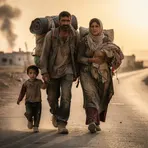
A person who must leave their country to escape war, danger, or disaster
 35
5.1
35
5.1
A person who leaves a dangerous place to stay safe, for example during a war or flood
 2
7.5
2
7.5
A person forced to leave their home because of war or danger
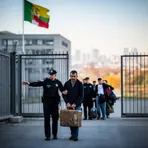
A person forced to leave their country, often for political or legal reasons
How Displaced

Surface Forms
Morphology
The phrase is a regular compositional combination: 'displaced' (removed or forced from a position/home) + 'person' yields 'a person who has been removed/forced from their home or country'. Although somewhat formal/technical, the past-participle adjective + noun pattern is transparent and common cross-linguistically, so a B1 learner who knows the constituents can reliably infer the meaning.
Etymology
Displaced person comes from the simple idea of someone who has been moved from their usual place. The word displaced means 'moved out of place', like furniture pushed out of its spot, so displaced person describes someone forced to leave their home, which is why it means someone 'forced to leave their home or country'.