
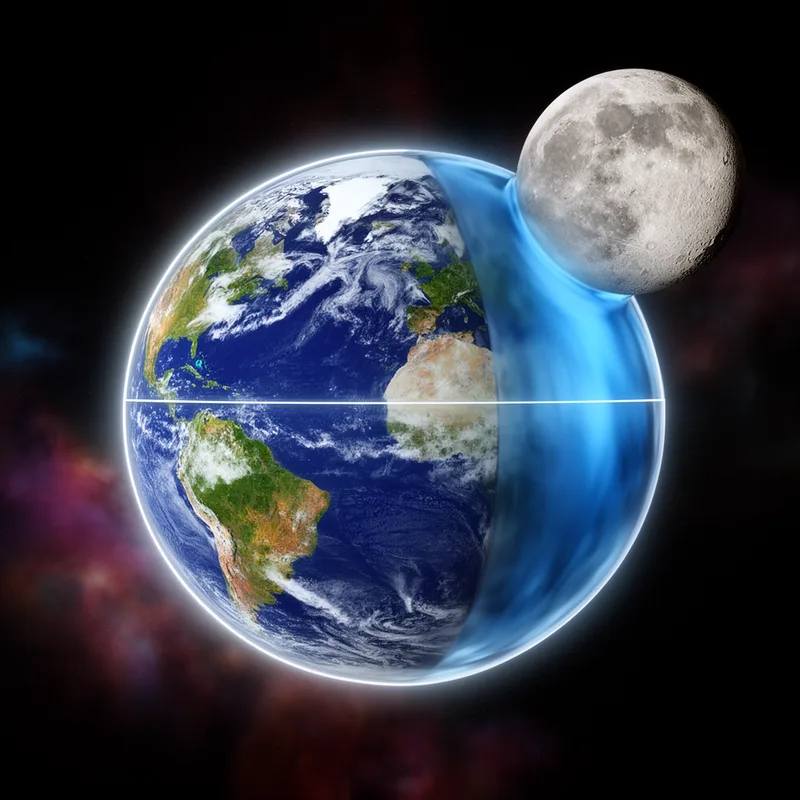
direct tide
- noun
- Specialized
- The phenomenon of a direct tide explains why there are two high tides each day in most coastal areas.
Examples
-
At the same time as the direct tide faces the moon, a second high tide occurs on the opposite side of the Earth.
-
The direct tide is influenced by the moon's gravity.
-
Scientists monitor the direct tide to better understand the effects of lunar gravity on the oceans.
-
During a direct tide, the water levels can rise significantly.
-
As the moon pulls on the oceans, a direct tide forms on one side of the Earth while a simultaneous high tide occurs on the opposite side.
-
Understanding the effects of the moon and sun on our oceans requires studying the direct tide, which indicates when two high tides happen at once.
-
In coastal regions, a direct tide helps explain the pattern of having two high tides per day, with one on each side of the Earth.
Synonyms

 26
1.8
26
1.8

The time when the sea reaches its highest level
 11
3.4
11
3.4
The time when the tide reaches its highest level

The time when the sea or river reaches its highest level
Surface Forms
Morphology
The phrase is compositional (direct + tide) so a B1 learner would likely infer it denotes a particular kind of tide 'directly' caused or aligned, but the specific geophysical sense — a simultaneous high tide on the opposite side of the Earth due to lunar/solar gravity — is technical and not predictable from the constituents alone. Because the core idea (a special type of tide) is partly inferable but the detailed mechanism and exact configuration require domain knowledge, this is best classified as semi-transparent.
Etymology
The noun direct tide comes from the simple image of the moon pulling the sea, so the water rises on the side facing the moon, the direct side, and this rise is a high tide. A matching rise on the opposite side makes a second 'high tide', so the name helps explain why many coasts have two high tides each day.