
diamagnetism


 1
9.9
- noun
- /ˌdaɪəˈmæɡnɪzəm/
- Specialized
- Landau's result was in flat contradiction to a classical argument by Niels Bohr and J. H. Van Leeuwen that there should be no diamagnetism at all!
Loading YouTube…
Watch on YouTubeThe second kind of magnetism is called diamagnetism.
- The second kind of magnetism is called diamagnetism.
Examples
-
And the the answer is, I think it's all to do with all these horrible things you learn about in magnetism, diamagnetism and paramagnetism.
-
The theorem fails because diamagnetism, a quantum phenomenon, cannot be approximated by any configuration of classical magnets, as considered in Earnshaw's theorem.
Academic text (1998) -
Topics included chemical physics, diamagnetism, and nuclear physics.
Academic text (2004) -
And the work that Tyndall did on diamagnetism is very accurate.
-
For example, in one chapter, diamagnetism is presented as an extension of atomic physics that explains spin and orbital moments.
Academic text (2003) -
In a subsequent chapter, paramagnetism is discussed as an effect that tends to overshadow diamagnetism.
Academic text (2003) -
Diamagnetism was discovered by Michael Faraday in 1846, but no one at the time thought that it could lead to any appreciable effects.
Academic text (1998) -
In 1933, the key discovery of perfect diamagnetism by Walter Meissner and R. Ochsenfeld in Berlin showed superconductivity to be a reversible thermodynamic phenomenon.
Academic text (1993) -
Owing to the readjustment of electron orbits in a magnetic field, all objects, even "nonmagnetic" ones, exhibit diamagnetism, which determines the lowest possible limit of their magnetic response.
Academic text (1998) -
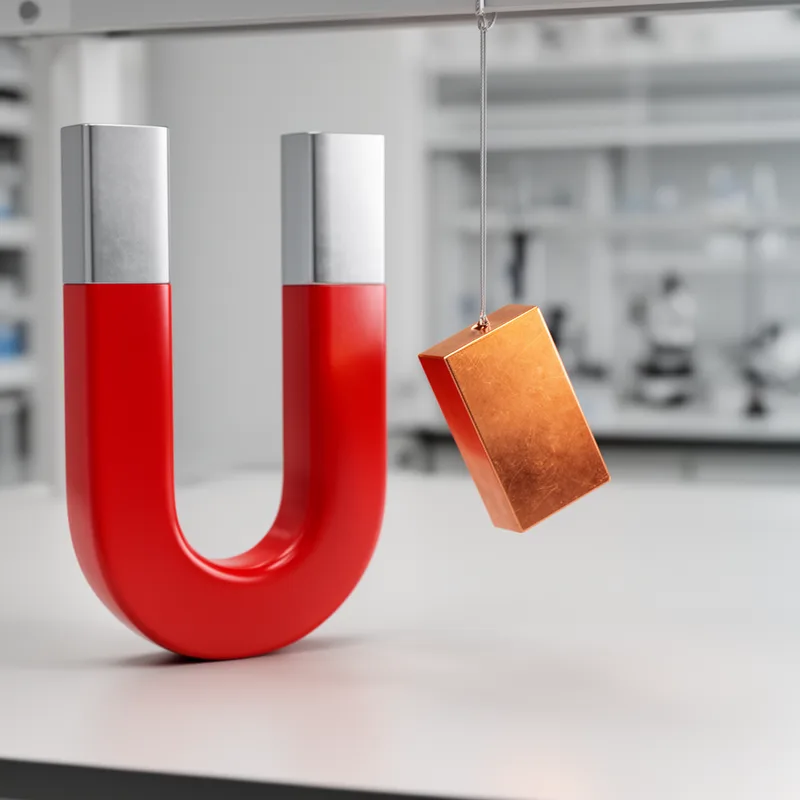
The property of diamagnetism causes materials like copper to be slightly repelled by a magnet when exposed to a magnetic field.
How Magnetic

Surface Forms
Morphology
diamagnetism = diamagnetic (semi-transparent) = dia + magnet + dia + ism
Standard noun formation from the adjective 'diamagnetic' using '-ism' to denote the property or phenomenon.
Etymology
Diamagnetism comes from the parts dia- meaning 'across' or 'opposite' and magnet from a word for a 'stone that pulls iron'. So, diamagnetism is when a material is pushed slightly away from a magnet, which is why metals like copper are weakly repelled.