
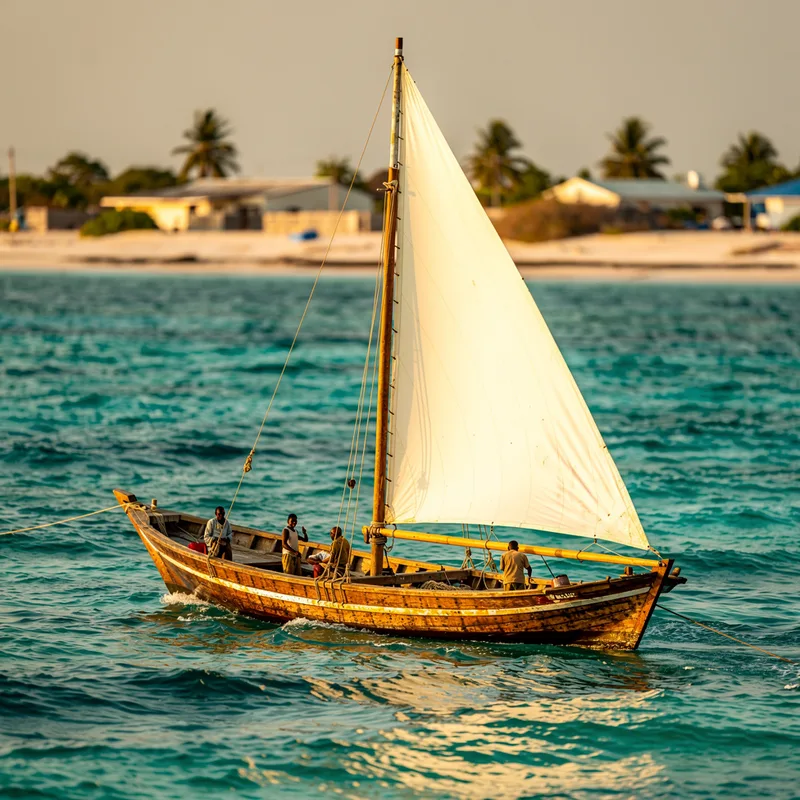
dhow
 2
9.9

- noun
- /daʊ/
- Now, every day as the sun warmed the Arabian Gulf, Farid and the other young Bahraini men went out in their wooden boats, called dhows, to dive for oysters.
- dhow sailing
- a traditional dhow
- wooden dhows
Examples
-
Until the advance of the Portuguese in the 16th century, dhows ruled the most lucrative maritime trade route in the world, from Madagascar to Canton.
Fiction book (2000) -
And behind him were others; the shell collector heard the hulls of four or five dhows come over the coral, heard the splashes as people hopped out to drag the boats ashore.
Fiction book (2001) -
These stamps depicted local scenes and local things; there was one called "Arab Dhow."
Academic text (2001) -
Some dhows were said to carry hundreds of tonnes of cargo at a time.
Fiction book (2000) -
Caruso sat in a native dhow, at anchor, a little way from shore.
Fiction book (2000) -
Dhows tipped and cruised the waters of the Nile.
Fiction book (1992) -
We sail aboard the Dubai I, a wooden trading dhow hand-built in the docks of Dubai, in the United Arab Emirates.
Fiction book (2000) -
We sail aboard a traditional dhow while exploring the beautiful coastline of Oman.
-
Many fishermen prefer to catch their daily haul using a classic dhow in the Indian Ocean.
-
Tourists enjoy a leisurely ride on a wooden dhow during sunset in the harbor.
Surface Forms
Etymology
Dhow comes from words used around the Indian Ocean — for example dau in Swahili and Arabic — where sailors called their small coastal boats by that name. A helpful image is its long body and triangular 'sails', so dhow today means a traditional Arab sailing boat used across the Indian Ocean.