
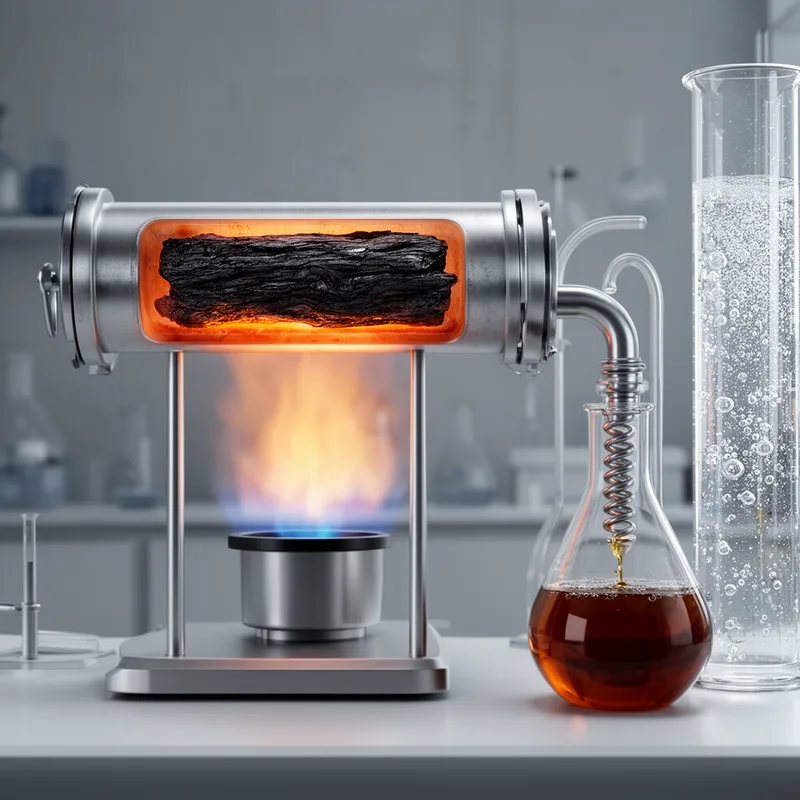
destructive distillation
- noun
- /dɪˈstrʌktɪv dɪstəˈleɪʃən/
- Specialized
- Destructive distillation of coal yields coke, coal tar, and coal gas.
Examples
-
Charcoal is made from wood by destructive distillation.
-
The process of destructive distillation is used to obtain chemicals from organic solids.
-
The process of destructive distillation is essential in producing charcoal.
-
Many industries utilize destructive distillation for various applications.
-
Destructive distillation of coal yields coke, coal tar, and coal gas.
-
The process of destructive distillation breaks down wood to produce charcoal and other byproducts.
-
During destructive distillation, solid materials are heated to release volatile compounds.
Surface Forms
Morphology
destructive + distillation
Partly inferable: 'destructive' (causing decomposition) combined with 'distillation' (a heating/separation process) would lead a B1 learner to guess this is a kind of heating that damages or breaks down a material. However, the precise technical sense (closed-vessel pyrolysis yielding volatile products rather than standard fractional distillation) is not predictable from the words alone, so it is not fully transparent.
Etymology
Destructive distillation comes from the simple picture of heating a solid in a closed pot so it is destructive, meaning the solid 'breaks down', and the gases and liquids are separated by distillation and 'collected'. So the term means heating a solid until it breaks into parts that can be taken and used.

