
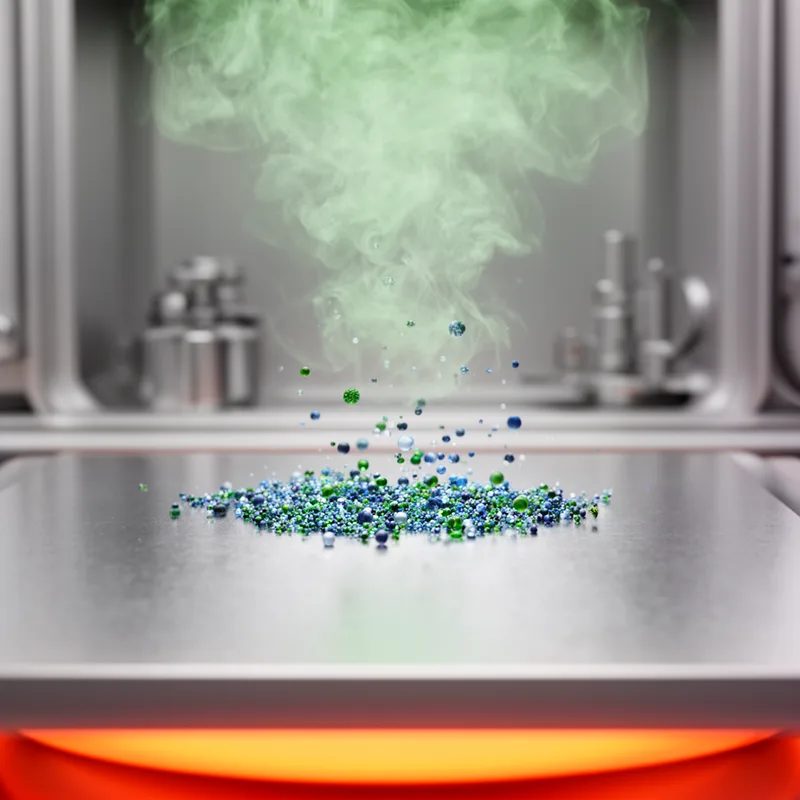
desorption


 1
9.9
1
9.9
- noun
- /dɪˈsɔːrpʃən/
- Specialized
- During the experiment, the researchers observed the desorption of gas from the solid surface when heated.
- Laser desorption
- desorption ionization
- thermal desorption
Examples
-
Air sample collection and desorption efficiencies were pooled into a single recovery efficiency based on actual air loads and CHA recovered.
Academic text (1993) -
Another method of removing contaminants from the soil is thermal desorption.
Academic text (1995) -
Since desorption requires energy to break surface bonds, temperatures as high as 900 K may be needed.
Academic text (1998) -
Today, one of the most important applications of ESI and laser desorption is protein identification.
Academic text (2002) -
The first mass loss stage before 100°C is attributed to the desorption of adsorbed water.
Academic text (2018) -
The steel tube was placed in the thermal desorption trap position in a purge and trap (HP 7965) sampler.
Academic text (1998) -
Fenn adapted the concept of electrospray ionization (ESI) to do the job, and Tanaka showed that laser desorption could work.
Academic text (2002) -
Nitrogen adsorption-desorption isotherms were measured at -196°C on a Micromeritics ASAP 2020 M instrument.
Academic text (2018) -
Thermal desorption is often used to clean contaminated soil by converting adsorbed pollutants into vapor.
-
The process of desorption enables the release of atoms from a surface, changing them from a solid to a gas.
Synonyms
 1
8.5
1
8.5
Release of gas from a solid material into the air or space

The release of gas from liquids or rocks
Antonyms

- Specialized
1
8.9
Tiny particles from a gas or liquid stick to a surface and form a thin layer
Surface Forms
Morphology
Etymology
Desorption comes from the prefix de- meaning 'remove' and the root sorb, seen in absorb, meaning 'to take in' or 'stick to'. So, desorption is the process of 'releasing' something that was stuck to a surface back into a gas or liquid.