
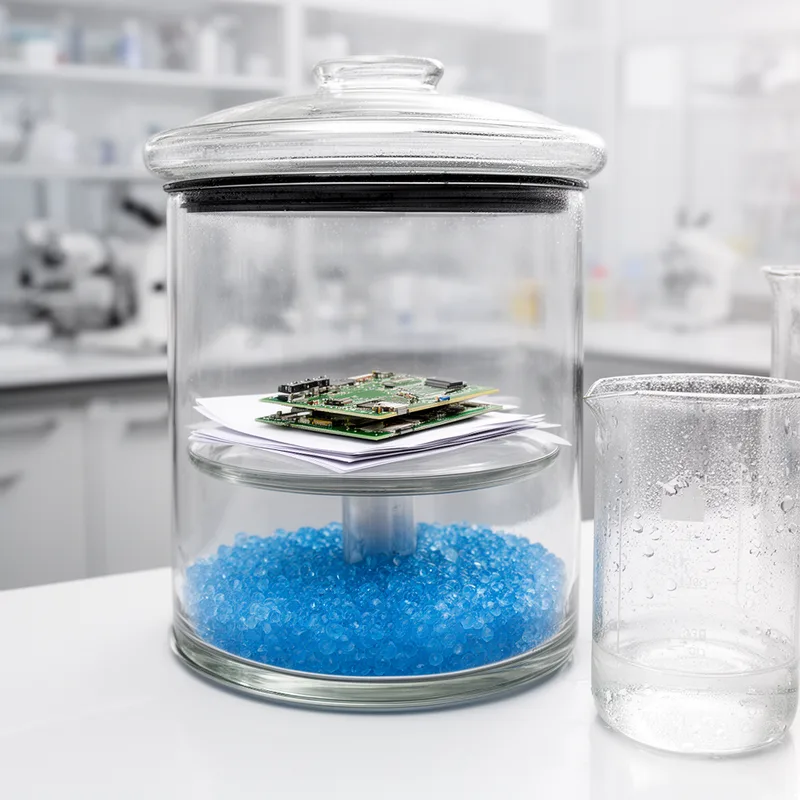
desiccator
- noun
- /ˈdɛsɪˌkeɪtər/
- Specialized
- In the laboratory, a desiccator is essential for preserving delicate materials by removing moisture.
Examples
-
After drying the samples, we placed them in the desiccator for storage.
-
Control (un-sprouted) samples were ground and stored in airtight bottles in desiccators for further analysis.
Academic text (2014) -
The flask was allowed to cool to room temperature in desiccators for approximately 30 minutes and was weighed.
Academic text (2015) -
Finally, the obtained AgNPs@NH2-CP was again washed thoroughly with water and dried in a vacuum desiccator for future use.
Academic text (2018) -
The vial was stored in a glass desiccator with sodium hydroxide to eliminate CO₂.
Academic text (2018) -
Briefly, 0.5 g of sample was heated at 100°C in an oven for 3 h, cooled to ambient temperature in a desiccator, and then weighed.
Academic text (2018) -
The chemicals were stored in a desiccator to keep them dry and free from moisture.
Synonyms
 3
3.7
3
3.7

A machine that dries food by removing water
How Dry
- Specialized

- Specialized
Surface Forms
Morphology
Etymology
Desiccator comes from the Latin parts de- 'completely' and siccare 'to dry', so the name literally means 'to make completely dry'. A desiccator is therefore a sealed container that keeps things dry by removing moisture.