
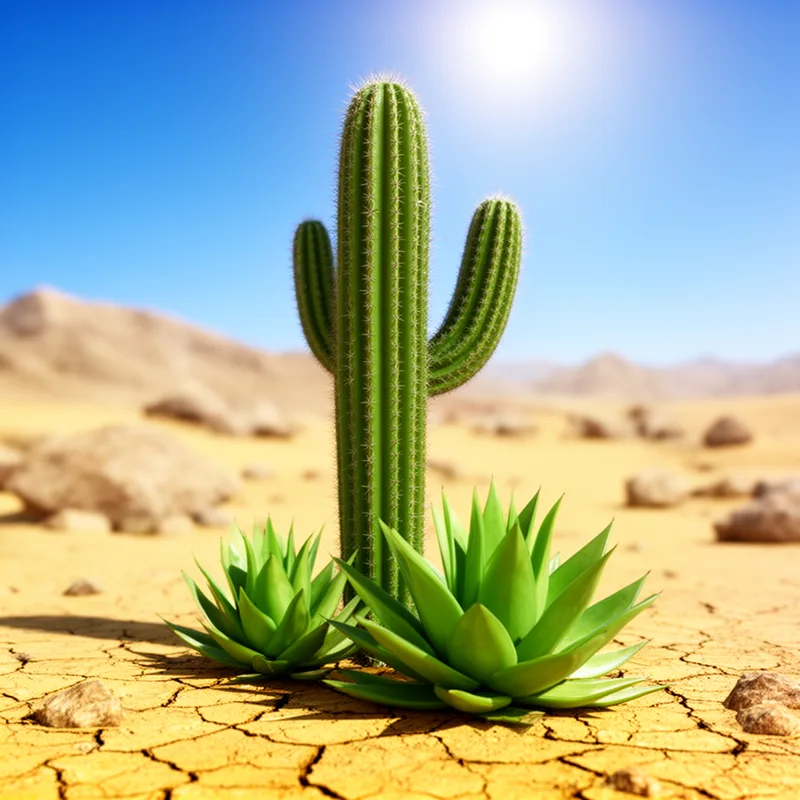
desert plant
 1
3.6
1
3.6

- noun
- /ˈdɛzərt plænt/
- A desert plant that has both leaves and photosynthetic stems has an excellent overall strategy for annual carbon gain.
- photosynthetic desert plant
- desert plant adaptations
- strategy for desert plant
Examples
-
Other desert plants may shed leaves—or entire branches—to cope with diminished water supplies.
Academic text (1995) -
However, not all desert plants have high rates of photosynthesis.
Academic text (1998) -
There are a few houses down our street that have done fantastic landscaping using desert plants.
Blog text (28) -
Many people wonder why so many desert plant communities are dominated by spiny species, most of them cacti.
Academic text (2010) -
In the desert, you can find many desert plants that have adapted to survive with little water.
-
Saguaro and prickly pear are well-known examples of desert plants that thrive in hot, dry climates.
-
Visitors can learn about desert plants that use unique techniques to conserve moisture in their harsh environment.
Synonyms

A plant that lives in very dry places, like a cactus, and stores water
A plant that can live with very little water

A plant like a cactus that lives in very dry places and uses little water
A plant or living thing that lives where there is very little water
How Drought-Tolerant

Surface Forms
Morphology
The meaning 'a plant adapted to survive in arid environments' is directly and transparently derived from combining 'desert' (a dry region) with 'plant' (a living photosynthetic organism). This noun-noun composition follows a common and cross-linguistically regular pattern, so a B1 learner who knows both constituents will readily understand the phrase.
Etymology
Desert plant names a plant that lives in a desert, a very dry place with little water. These plants often store water in thick leaves or stems and have spines or small leaves to save moisture, so 'desert plant' means a plant that can 'survive' with very little water.