
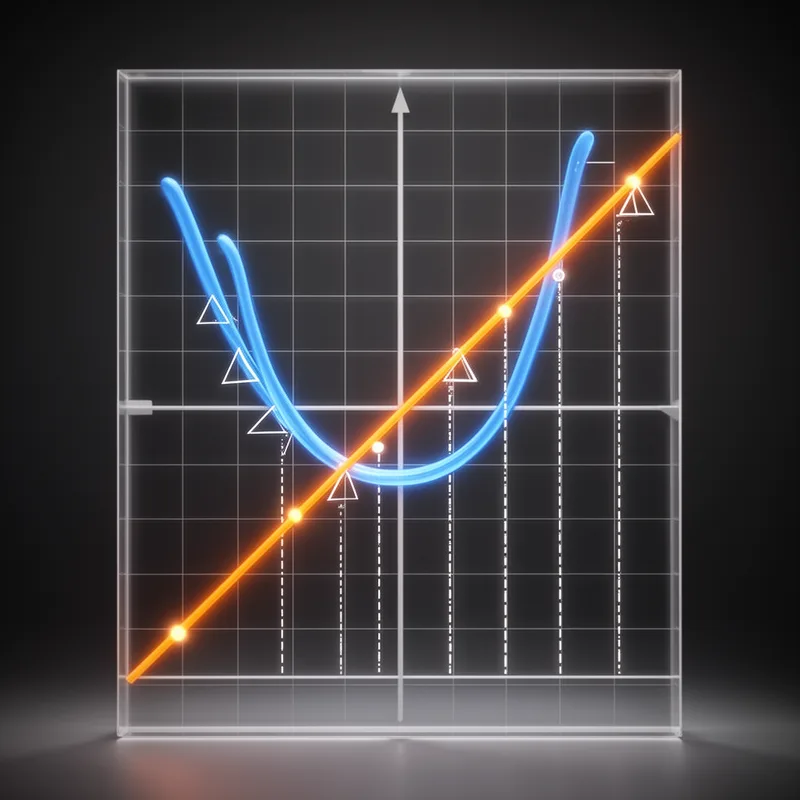
derived function
- noun
- /dɪˈraɪvd ˈfʌŋkʃən/
- Specialized
- The derived function of f(x) tells us the slope at any given point.
Examples
-
The derived function represents the slope of the tangent line.
-
We can calculate the derived function of f(x) = x^2.
-
If the original curve is quadratic, its derived function will be linear.
-
In calculus, finding the derived function is one of the main operations.
-
If the original curve is quadratic, its derived function will be linear, showing how the output changes with respect to the input.
-
In calculus, the process of finding the derived function for a given function helps determine its rate of change at any point.
-
The derived function of f(x) indicates the slope of the graph at any point, providing insight into the behavior of the original function.
Synonyms

 7
9.3
7
9.3

A very small change in a number used to show how fast it changes, like dy or dx
 6
9.6
6
9.6
The rate a function changes at a point


 1
7.9
1
7.9
How fast one value changes compared with another at a particular point

The rate at which a curve goes up or down at one point
Surface Forms
Morphology
The combination of 'derived' (formed from another) and 'function' (a mapping) lets a learner infer a function that comes from another function, so the basic compositional idea is clear. However, the precise mathematical sense—that it is obtained by differentiation and represents a rate of change—is technical subject knowledge beyond general word meanings, making the expression only partially predictable.
Etymology
The noun derived function comes from the idea that one function is 'taken from' another by a calculation. Imagine the original curve as a road and the derived function as a speedometer that shows how steep the road is at each point, so it tells the 'rate of change'.