
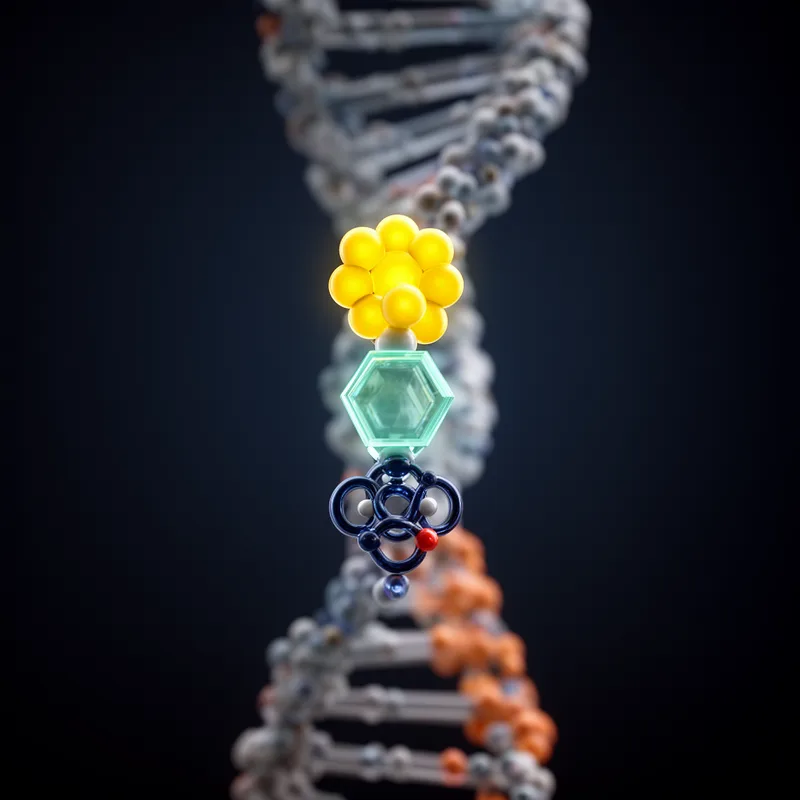
deoxyadenosine monophosphate


 1
9.9
- noun
- /diːˌɒksiˌædɛnəˈsaɪn mɒnəˈfɔːsfeɪt/
- Specialized
- Scientists often abbreviate deoxyadenosine monophosphate as dAMP in genetic studies.
Examples
-
The presence of deoxyadenosine monophosphate is essential for the formation of the DNA double helix.
-
The deoxyadenosine monophosphate molecule is essential.
-
During DNA replication, deoxyadenosine monophosphate pairs with thymine on the complementary strand.
-
Wow! This deoxyadenosine monophosphate is fascinating!
-
Deoxyadenosine monophosphate, or dAMP, is essential for DNA synthesis in living organisms.
-
The nucleotide deoxyadenosine monophosphate plays a crucial role in genetic information storage.
-
Researchers use deoxyadenosine monophosphate to study the structure of DNA.
Surface Forms
Morphology
deoxyadenosine + monophosphate
The term is a straightforward technical compound: it combines 'deoxyadenosine' (adenine + deoxyribose nucleoside) with 'monophosphate' (a single phosphate group), so its meaning as the deoxyadenosine molecule bearing one phosphate is directly derivable from the parts. Although specialized, the composition follows regular morphological/scientific naming patterns (mono- + phosphate), making it predictable to a learner who knows the constituent elements.
Etymology
Deoxyadenosine monophosphate breaks into three parts: deoxy- ('without oxygen'), adenosine (adenine plus a sugar), and monophosphate ('one phosphate'). That's why the name means one of the DNA building blocks made of the base adenine, a sugar missing an oxygen, and a single phosphate.