

degree Celsius
 28
2.2
28
2.2

- noun
- /dɪˈɡri ˈsɛlʃəs/
- Twenty degrees Celsius and still dropping.
- temperature degrees Celsius
- 37 degrees Celsius
- -70 degrees Celsius
Loading YouTube…
Watch on YouTubeBut at the same time nature does not think in terms of degrees Celsius, even degrees Fahrenheit.
- But at the same time nature does not think in terms of degrees Celsius, even degrees Fahrenheit.
Examples
-
A fever was defined as a temperature of 37.5 degrees Celsius or higher.
Academic text (1992) -
Current temperature is 43 degrees Celsius.
-
Water temperature below three degrees Celsius.
-
24 degrees Celsius, with perfect beach conditions forecast.
-
A temperature of 36 degrees Celsius was chosen to produce moderate heating of the skin.
Academic text (1999) -
The local temperature is 30 degrees Celsius…
-
Four degrees Celsius today.
-
Over the last several decades, we have raised the Earth's average temperature by 0.7 degrees Celsius.
-
Development of the larvae to Stage IV at 20 degrees Celsius in outdoor tanks takes about 2 weeks.
Academic text (1999) -
The temperature outside dropped to five degrees Celsius yesterday.
Synonyms
 5
3.3
5
3.3
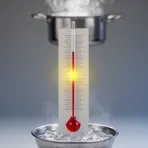
A unit of temperature on the Celsius scale
 3
2.3
3
2.3
A degree on the Celsius temperature scale
Surface Forms
Morphology
The phrase 'degree Celsius' is fully compositional: 'degree' (a unit) combined with 'Celsius' (a temperature scale) directly yields a temperature unit. This measurement construction is cross-linguistically common and follows standard noun–noun composition, so a B1 learner who knows both constituents will understand the meaning.
Etymology
Degree Celsius is named after the Swedish scientist Anders Celsius, who made a temperature scale using water's freezing and boiling points. He divided the gap between these two points into 100 equal steps, so a degree is one of those steps. That's why degree Celsius means a unit of 'temperature' tied to water's freezing and boiling points.