
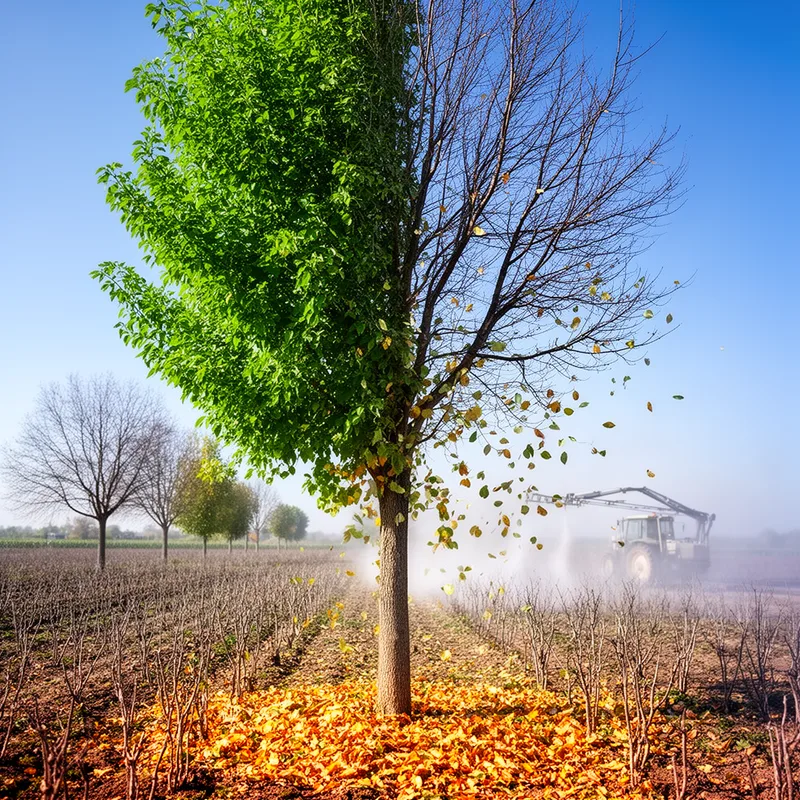
defoliation


 1
7.0
1
7.0
- noun
- /dɪˌfoʊliˈeɪʃən/
- Specialized
- Trees on the southwest slopes of the mountains suffered fewer broken or uprooted stems, with canopy damage limited mainly to defoliation and debranching.
Examples
-
The severity of wind damage to vegetation ranges from defoliation to debranching, stem breakage, and uprooting.
Academic text (1997) -
Even within the high-impact list, the damage associated with species varies substantially, ranging from insects that cause minor defoliation or aesthetic injury to insects that cause extensive tree mortality.
Academic text (2010) -
Defoliation by herbicides made the enemy more visible to U.S. air and land forces and prevented surprise attacks.
Academic text (1990) -
Have natural succession and the composition of eastern American oak forests been significantly and forever altered due to chronic, heightened defoliation by the gypsy moth?
Academic text (1996) -
Coniferous trees, which do not have the ability to releaf after defoliation, died, but some deciduous trees survived (Adams et al. 1987).
Academic text (1997) -
Although drought affected large areas, tree mortality was extremely patchy, and there was often a wide spectrum of responses from partial crown defoliation to whole-tree mortality.
Academic text (2018) -
Defoliation by the chrysomelids will be more spectacular, but the devastation of the rootstock by weevil larvae will have a long-term negative impact on plant performance.
Academic text (1993) -
The sudden defoliation of the trees left the forest looking bare and exposed.
-
Farmers used chemicals to induce defoliation before harvest to ensure a better yield.
-
During the fall, natural defoliation occurs as trees shed their leaves in preparation for winter.
Synonyms
 3
3.4
3
3.4
Losing hair or leaves naturally from animals and plants

A plant that loses its leaves every year
Antonyms
How Leafless

Surface Forms
Morphology
defoliation = defoliate (semi-transparent) = de + foli + ate + ion
Adding '-ion' to the verb 'defoliate' transparently forms a noun meaning the process or result of removing leaves.
Etymology
The word defoliation comes from the parts de- meaning 'remove' and foli- meaning 'leaf', the same root you see in foliage. So defoliation is the loss or removal of leaves from plants, whether by natural causes or by chemicals.