
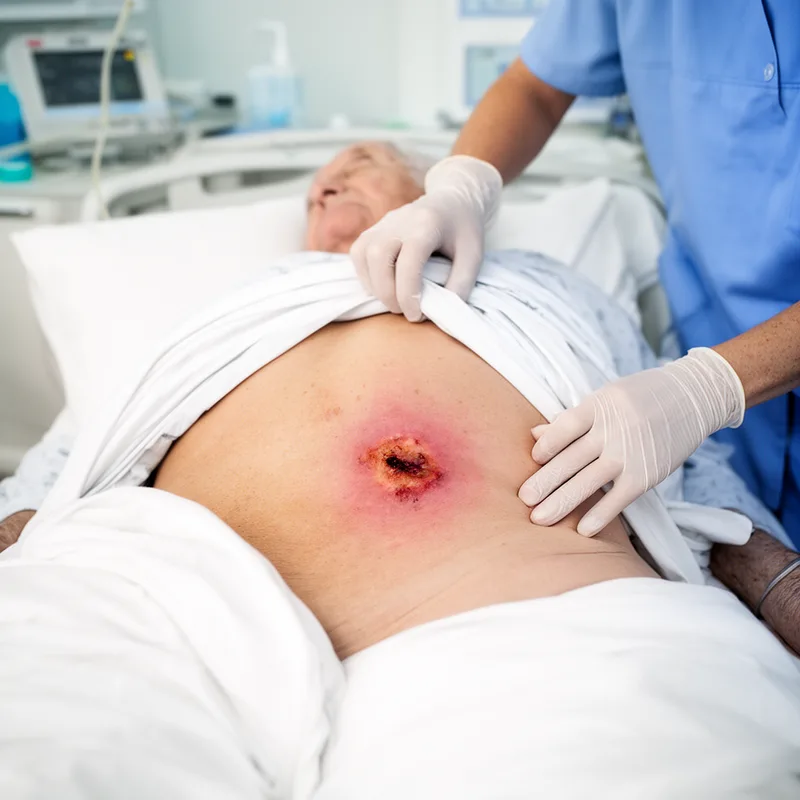
decubitus ulcer
- noun
- /ˈdɛkjʊbɪtəs ˈʌlkər/
- Specialized
- To prevent a decubitus ulcer, caregivers should regularly change the position of patients who are unable to move on their own.
Examples
-
Development of decubitus ulcers is a serious problem for wheelchair users, who sometimes sit in their chairs from 12 to 16 hours per day.
Academic text (1994) -
Patients who are bedridden for long periods can develop a decubitus ulcer due to the constant pressure on certain areas of their skin.
-
Key words: cushions, decubitus ulcer, force plate, pressure sore, seating pressure, shear force, wheelchair.
Academic text (1990) -
While buttock-cushion interface pressures are used in cushion design, surgical evidence suggests that decubitus ulcers form within the internal tissues and progress toward the surface.
Academic text (1994) -
Key words: bedsore, collagen, decubitus ulcer, elastin, pressure, pressure ulcer, skin.
Academic text (2001) -
Literature discussing the formation of decubitus ulcers gives ranges of interface pressures associated with their onset (7, 24, 25).
Academic text (1994) -
The interest in shear stems from the observation that shear force increases the possibility of inducing a decubitus ulcer.
Academic text (1990) -
Research studies show a prevalence of decubitus ulcers in 11 percent of the hospitalized population and in 20 percent of nursing home residents at any given time (1).
Academic text (1995) -
Key words: biomechanics, computer models, decubitus ulcer, feasibility studies, magnetic resonance imaging, mechanical stress, pressure, wheelchairs.
Academic text (1994) -
It has been found that some people who fail to relieve pressure from their ischial tuberosities as often as is suggested have no problem with decubitus ulcers (7, 8), while others, under the same circumstances, are more apt to develop them.
Academic text (1991)
Synonyms
 81
3.7
81
3.7

A painful sore on the skin or inside the body that can make pus
 5
4.2
5
4.2
A painful sore on the skin caused by lying in one position for a long time
 1
7.0
1
7.0
An open sore on the skin or in the mouth that hurts and often looks red
 1
4.6
1
4.6
A damaged area of skin that appears when constant weight on it keeps blood from reaching it


 1
9.9
1
9.9
A sore on the skin caused by long pressure from lying in one position
How Severe
- Specialized
 11
3.7
11
3.7
Surface Forms
Morphology
The noun 'ulcer' clearly indicates a sore and 'decubitus' (from Latin meaning lying down/related to pressure) specifies the cause, so a learner who knows both constituents can infer it is a sore caused by prolonged pressure. Because 'decubitus' is a specialized medical/Latin term rather than a productive, everyday modifier, the connection is partially predictable but relies on technical knowledge.
Etymology
Decubitus ulcer comes from Latin words: decubitus meaning 'lying down' and ulcer meaning 'sore'. The name paints a simple picture — someone who lies in bed too long gets a sore from pressure, so today it means a sore caused by long pressure on the skin.