

to declare allegiance


 1
6.6
1
6.6
- phrasal verb
- /dɪˈklɛr əˈliːdʒəns/
 :
declarar lealtad
:
declarar lealtad
- The soldiers gathered to declare allegiance to their new commander during the ceremony.
Examples
-
Before joining the organization, she had to declare allegiance to its core values and mission.
-
The activist background of some of the HRCP's founding members and the organization's declared allegiance to secular democracy.
Academic text (2005) -
The GSPC later declared allegiance to al-Qaida, changed its name to AQIM, and turned its southern wing into a money-making operation.
Blog text (14) -
During the rally, many citizens chose to declare allegiance to the movement for social justice.
Synonyms
 229
5.3
229
5.3
To officially announce something to the public
 183
4.2
183
4.2
To publicly show support for a person or idea
Antonyms

Surface Forms
Morphology
The meaning 'to publicly announce loyalty or support' is directly and transparently derivable from 'declare' (to state/announce) + 'allegiance' (loyalty), so an average B1 learner who knows both words can infer the MWE's meaning. This verb + noun composition follows common cross-linguistic patterns and standard English collocational logic, making it immediately comprehensible without prior exposure.
Etymology
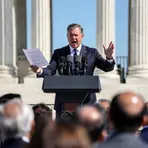
Declare allegiance comes from old public promises to a leader or country. People would stand before others and loudly declare their allegiance, that is, say their loyalty, often with a raised hand, so the phrase now means 'to publicly announce loyalty or support'.