

death's-head moth
- noun
- /ˈdɛθzˌhɛd mɔθ/
- The naturalist spotted a death's-head moth resting on the bark of a tree, fascinated by its unique skull-like marking.
Examples
-
The museum exhibit featured a stunning death's-head moth display, highlighting its distinct appearance and life cycle.
-
During the evening stroll, they noticed a death's-head moth fluttering around the garden lights.
-
Then, as we pull slowly away, we see that her staring eyes and his dead gaze are both locked onto a death's-head moth perched on an infrared bulb overhead, its wings pumping slowly.
Fiction book (1991)
Synonyms


 1
8.1
1
8.1
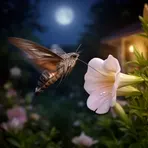
A large moth with long wings that hovers to drink flower nectar
 1
6.5
1
6.5
A large night insect with long wings that hovers to drink flower nectar

A large moth from Europe with a pattern like a human skull on its back
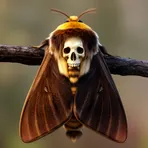
A large moth with a skull-shaped mark on its back
Surface Forms
Morphology
death's-head + moth
The compound 'death's-head' is compositionally built from 'death' + 'head' and readily evokes a skull or skull-like marking; combined with 'moth' a B1 learner who knows the constituent words can infer it denotes a moth with a skull-like marking. This morphological logic is straightforward and cross-linguistically plausible, so the overall meaning is directly derivable from the parts.
Etymology
Death's-head moth comes from a dark mark on the insect's back that looks like a skull. The part death's-head refers to that 'skull-shaped marking' and moth is the insect, so the name simply means a moth with a skull on its back.