

Acherontia atropos
- noun
- Specialized
- The distinctive skull-like pattern on the back of the Acherontia atropos has inspired many myths and legends.
Examples
-
The Acherontia atropos, or death's-head hawkmoth, is often associated with superstition in European folklore.
-
The Acherontia atropos is known for its distinctive skull-like markings.
-
During our trip, we saw an Acherontia atropos resting on the garden wall at dusk.
-
Look at that Acherontia atropos!
-
While hiking in the countryside, we spotted an Acherontia atropos resting on a flower, its remarkable skull-like markings clearly visible.
-
The Acherontia atropos, commonly referred to as the death's-head hawkmoth, is often mentioned in literature due to its eerie appearance.
-
Many people are fascinated by the Acherontia atropos because of its unique skull pattern and its role in various cultural superstitions.
Synonyms


 1
8.1
1
8.1
A large moth with long wings that hovers to drink flower nectar
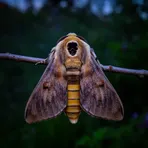
A large moth with a skull-shaped dark mark on its back
Surface Forms
Morphology
The item is a Latin binomial made of two proper names (a taxonomic genus and a mythological epithet), so its referent (a particular species of hawkmoth with skull-like markings) is not derived by ordinary English compositional rules. Even if a learner knows that 'Atropos' relates to death, knowing the constituents does not reliably lead a B1 learner to infer the specific meaning without biological/taxonomic knowledge.
Etymology
Acherontia atropos has a dark, skull-like mark on its back, so people call it the 'death's-head hawkmoth'. Its species name 'atropos' comes from an old story about a figure who ends life, so the moth has long been linked to 'death' and superstition.