

deadstick landing
- noun
- /ˈdɛdˌstɪk ˈlændɪŋ/
- Specialized
- The pilot managed a deadstick landing after both engines failed mid-flight.
Examples
-
The pilot performed a deadstick landing after the engine failed.
-
During training, we practiced deadstick landings in various conditions.
-
Achieving a successful deadstick landing requires training and quick decision-making.
-
During the test flight, a simulated deadstick landing was carried out safely.
-
The pilot managed a deadstick landing after both engines failed mid-flight.
-
During the test flight, a simulated deadstick landing was carried out safely.
-
Achieving a successful deadstick landing requires training and quick decision-making.
Synonyms
 1
4.2
1
4.2

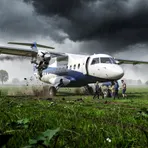
A landing that happens because of a sudden problem or bad weather
How Guided
- Specialized

- Specialized

 1
5.5
1
5.5
- Specialized
- Specialized
Surface Forms
Morphology
deadstick + landing
While 'landing' is transparent, 'deadstick' is specialized aviation jargon and not a productive combination a B1 learner would reliably interpret from 'dead' + 'stick'. A learner might infer 'dead' = not functioning, but 'stick' does not clearly signal engine failure to non‑specialists, so understanding the specific meaning ('without engine power') requires domain knowledge. The construction is therefore partially compositional but not fully predictable.
Etymology
Deadstick landing comes from pilots calling a plane a dead stick when its engine stopped and had no power. Imagine the aircraft gliding with engines off while the pilot uses the control stick to guide it to the ground, so the phrase means 'a landing without engine power'.