
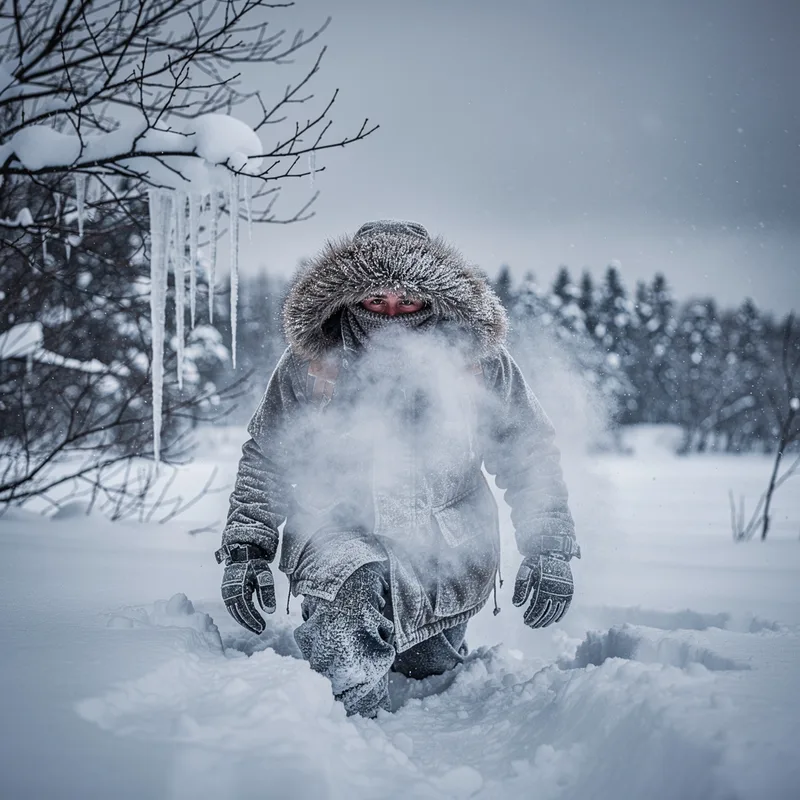
dead of winter
 8
3.9
8
3.9

- noun
- /dɛd ʌv ˈwɪntər/
- UK
- I can't imagine how horrible it must be to have no heat in the dead of winter.
Examples
-
Packer's problems started when his party tried to cross the San Juan Mountains in southwestern Colorado in the dead of winter.
Academic text (2002) -
In the dead of winter, her skin and hair seemed magically touched with the sun.
Fiction book (1995) -
When I first came to US, it was the dead of winter.
-
Why else is a train... so full in the dead of winter?
-
In the first place, it was in the dead of winter, and I had no warm clothes with me.
Fiction book (1995) -
In the dead of winter, they rose at three in the morning to warm up the car.
Fiction book (1999) -
Do you have any idea what it costs to heat a pool in Connecticut in the dead of winter?
-
It was the dead of winter, no food, no water.
-
That's why I'm up here in the dead of winter talking about it with you folks.
Fiction book (1995) -
In the dead of winter, the temperature often drops below freezing.
Synonyms
 5
3.5
5
3.5
The middle part of winter that is often the coldest time
Antonyms


How Cold
- UK
8
3.9
 5
3.5
5
3.5
Surface Forms
Morphology
Here "dead" is used metaphorically as an intensifier meaning the absolute or central point of the season (as in "dead of night" or "dead center"), not its literal sense 'not alive'. Because this is a non-literal, idiomatic extension that a B1 learner who only knows the basic senses of the words may not predict reliably—and because many languages use different constructions for the same idea—the phrase is best judged semi-transparent.
Etymology
Dead of winter comes from the idea that dead meant 'still' or 'lifeless', when trees are bare and everything is quiet and people stay indoors. That's why the phrase now means the coldest, hardest part of winter.