
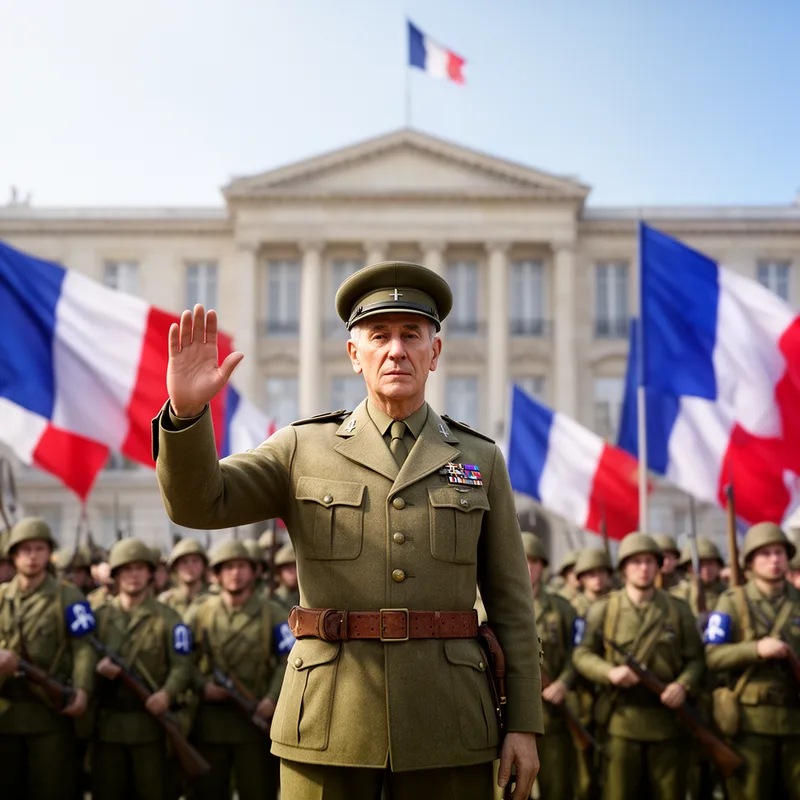
de Gaulle
 11
7.5

- proper noun
- /də ˈɡɔl/
- The American government concluded that de Gaulle was simply not that important; his movement was a mere symbol of resistance capable of a negligible military contribution.
- Charles de Gaulle
Examples
-
Jacques Maritain outlined his views of the French political situation in a long and thoughtful letter to General de Gaulle on 21 November 1941.
Academic text (1991) -
In public speeches, like General De Gaulle, he sometimes refers to himself in the third person.
Academic text (2002) -
De Gaulle led the Free French Forces, or French Resistance, during the Nazi occupation of France.
Blog text (9) -
After the war in 1946, a reluctant Charles de Gaulle finally permitted the withdrawal of French troops from Syria and then Lebanon.
Academic text (2002) -
The future provisional government is to be presided over by de Gaulle and created by him: that is the only way to save France from anarchy.
Academic text (1991) -
On the spur of the moment, de Gaulle ordered Admiral Muselier to seize the Vichy-controlled islands off the North American coast without informing anyone.
Academic text (1991) -
Leonid Brezhnev was in the Kremlin, the Cold War was at its height, and Charles de Gaulle had pulled France out of NATO's unified military command, forcing the other allies to move from Paris to Brussels.
Academic text (2002) -
Many people felt that President de Gaulle had betrayed the country by giving independence to Algeria.
-
And then he went off to France, where he met de Gaulle.
-
French President de Gaulle (center) is mobbed by well-wishers during a 1960 visit to Algeria.
Synonyms
 5
5.9
A French general and politician who led Free French forces in World War II and later became President of France
 1
5.8
A French army leader and later president who led the Free French forces in World War II

 1
7.2
A French general and statesman who led France in World War II
Surface Forms
Morphology
de + Gaulle
This is a proper name referring to the historical figure Charles de Gaulle; the referent cannot be inferred from the parts. 'de' is a name particle (and not an English lexical item) and 'Gaulle' is a surname, so knowing the literal constituents does not allow a B1 learner to derive the person's identity or biographical meaning.
Etymology
De Gaulle comes from Charles de Gaulle, a French general who made a famous radio call during World War II and later became president. Because he stood for French pride and strong leadership, people use his name for streets and buildings and see de Gaulle as a 'symbol' of France.