

darkling ground beetle
- noun
- /ˈdɑrk.lɪŋ ɡraʊnd ˈbiː.təl/
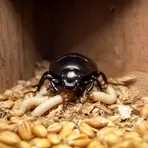
- Farmers sometimes find darkling ground beetles around stored grain, where their larvae feed.
Examples
-
The scientist discovered a darkling ground beetle under a rotting log in the forest.
-
A darkling ground beetle crawls along the damp earth, searching for decaying leaves to feed on.
-
A darkling ground beetle moves slowly in the shadows, blending in with the rich soil.
-
The darkling ground beetle is often found in gardens.
-
Have you seen a darkling ground beetle before?
-
You can spot a darkling ground beetle in your garden, especially near piles of compost or decaying plants.
-
The darkling ground beetle is a beneficial insect, as its larvae consume harmful fungi and decaying organic matter.
Synonyms
 1
9.1
1
9.1

A dark, hard-bodied beetle whose young often eat dead plants or stored grain

A hard, dark beetle whose young eat dead plants or stored grain
Surface Forms
Morphology
The phrase is compositionally built: 'darkling' (shadowy/dark) modifies 'ground beetle' (a beetle that lives on the ground), so the meaning — a dark or shadowy ground-dwelling beetle — is directly inferable from the parts. This adjective+noun and noun-noun compound pattern is regular in English (and common cross-linguistically), so a learner who knows the constituents can understand the MWE.
Etymology
Darkling ground beetle comes from a simple picture: darkling means 'in the dark' and ground beetle means 'on the ground'. These dark, slow beetles hide under soil or logs and their young eat rotting plants or stored grain, so the name fits the insect we mean.