
danse macabre
- noun
- /dɑːns məˈkɑːb/
- Literature
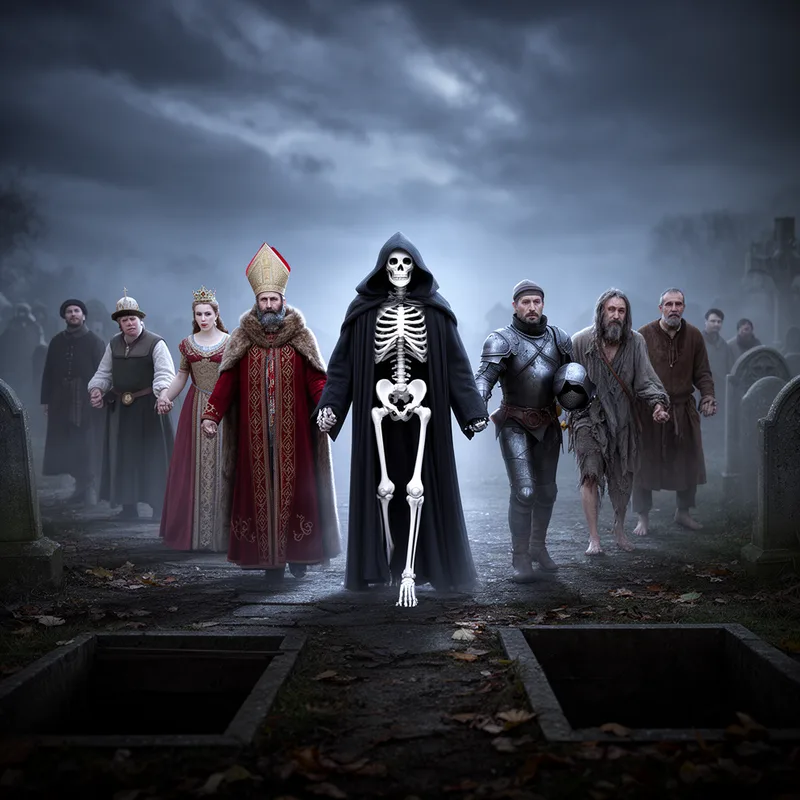
- Many famous artists depicted the danse macabre to illustrate that death comes for everyone, regardless of their status.
Examples
-
The same may be said of the archetypal danse macabre and of portions of many Doom or Last Judgment paintings, where emblematic flowers and trees depict an earth poised precariously between Heaven and Hell.
Academic text (2016) -
The figures of the Queen and Duchess are ubiquitous in the danse macabre genre.
Academic text (2016) -
Two aspects of the medieval eschatological tradition in particular ritualize such spatial inversion: the cadaver or transi tomb, and the danse macabre.
Academic text (2016) -
In medieval times, the danse macabre was a popular theme in art, illustrating how all people must eventually face Death.
-
The play included a haunting danse macabre scene, reminding the audience that life is fleeting for everyone.
Synonyms
 1
9.9
1
9.9

An image showing death as a skeleton leading rich and poor people to the grave
Surface Forms
Morphology
danse + macabre
The element 'macabre' clearly signals death-related meaning and 'danse' is a direct cognate of English 'dance', so a learner who knows both words can infer a literal 'dance of death'. However, the MWE is a borrowed, culturally specific medieval motif with figurative/historical nuances (Death leading all ranks) that go beyond simple compositional meaning, so it is not fully predictable.
Etymology
The phrase danse macabre comes from the Middle Ages and shows a picture of a dance with death, where Death leads people of every rank to the grave. That's why danse macabre means 'the idea that death comes for everyone, rich or poor'.