
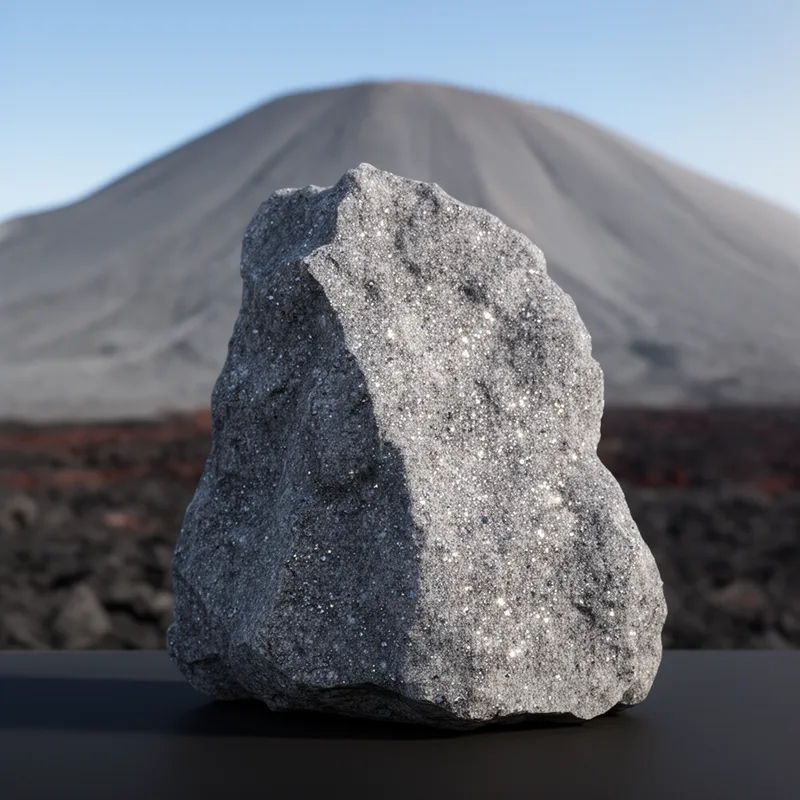
dacite
- noun
- /ˈdæsɪt/
- Specialized
- Geologists often study dacite to understand volcanic activity and the formation of the Earth's crust.
Examples
-
Some lava domes are formed almost entirely of dacite, resulting in unique geological structures.
-
The mountain was primarily composed of dacite, giving it a distinctive grey hue.
-
Geologists collected samples of dacite from the volcanic outcrop for further analysis.
-
The geologist examined the dacite sample closely.
-
Many dacites are found in volcanic regions.
-
The cliff was made of dacite, which is a type of volcanic rock known for its grey color and mineral content.
-
After the eruption, layers of dacite were exposed, revealing the rock's unique crystalline structure.
Synonyms
 4
3.6
4
3.6

A hard rock made when hot melted rock cools on or near the Earth's surface
Surface Forms
Morphology
dacite = Dacia (semi-transparent) = dac + ite
The suffix '-ite' clearly marks a mineral (transparent), but the base 'dac-' derives from the place name Dacia and is not recognizable to most learners, so overall the word is only partly transparent.
Etymology
The word dacite is named after Dacia, an old region in eastern Europe now part of Romania. It simply means 'rock from Dacia', which explains why the name is used for this grey volcanic rock.