
cytoskeleton
 1
7.9

- noun
- /ˌsaɪtəˈskɛlɪtən/
- Specialized
- And essentially what is being formed is a physical connection between the contractile cytoskeleton and the outside world.
- actin cytoskeleton
- cytoskeleton and cell
- cytoskeleton-interacting proteins
Examples
-
A special case of lasting structural time windows is cytoskeleton rearrangements.
Academic text (2017) -
And this movie really illustrates the principles underlying how the cytoskeleton is controlled.
-
They walk like this and they have to walk all the way down the cytoskeleton to get there so that they can just wait for the right signal.
-
Tonofilaments in the cytoplasm converge on the desmosomal plaque; thus, desmosomes also serve as sites of attachment of the cytoskeleton to the cell surface.
Academic text (1995) -
Cytoskeleton-based motor proteins can drive selective axonal cargo transport in a regulated manner (Kapitein and Hoogenraad, 2011).
Academic text (2016) -
Furthermore, experiments have demonstrated that the cytoskeleton, or cellular scaffolding, is not stationary but instead flows within the cell, so a comprehensive motility model would need to incorporate the viscoelastic dynamics of the actin network.
Academic text (2012) -
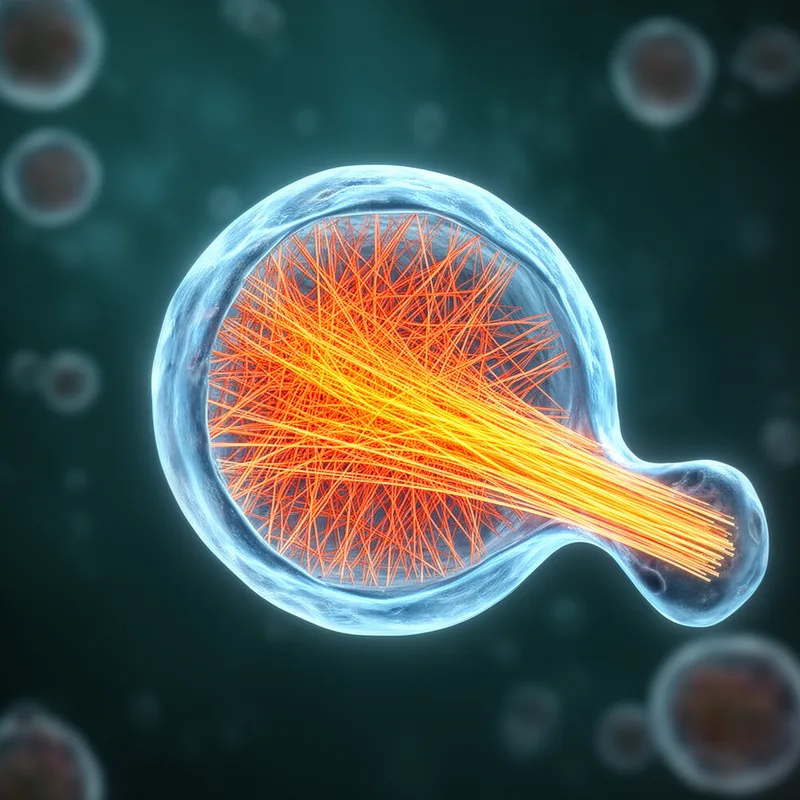
The cytoskeleton provides structural support, helping the cell maintain its shape and enabling movement.
-
Without a well-functioning cytoskeleton, cells would struggle to maintain their integrity and perform essential functions.
-
The cytoskeleton is essential for processes such as cell division and intracellular transport.
Surface Forms
Morphology
Etymology
Cytoskeleton combines cyto- meaning 'cell' and skeleton meaning 'frame' or 'support', just like the skeleton in your body. So the Cytoskeleton is the cell's inside frame that keeps its shape and helps it move.