
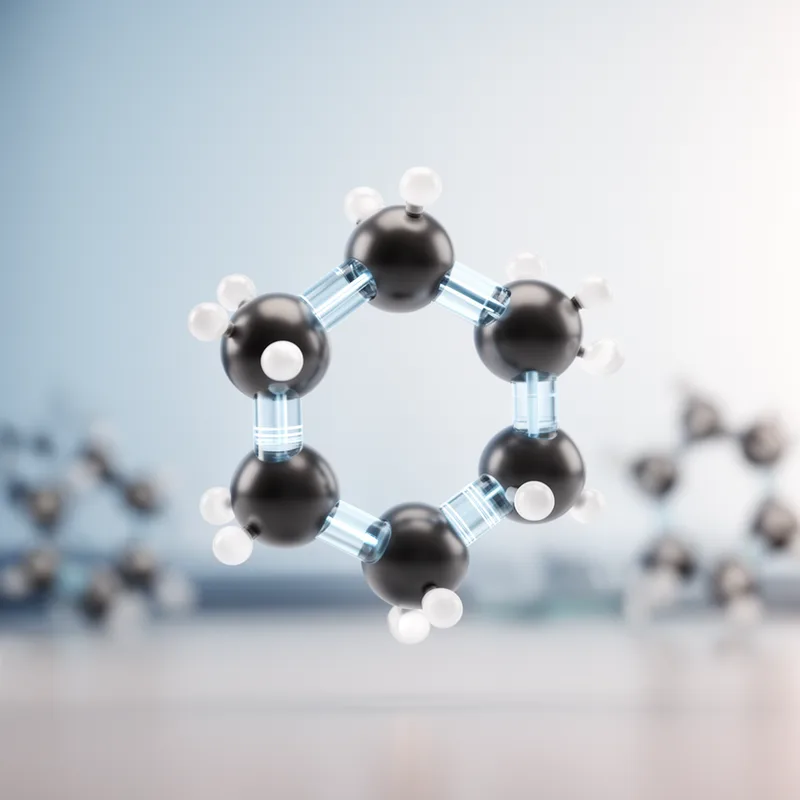
cycloolefin
- noun
- /ˌsaɪkloʊˈoʊlɪfɪn/
- Specialized
- The new cycloolefin compound demonstrated exceptional clarity when used as a lens material.
- cycloolefin polymer
- behavior of cycloolefin
Examples
-
Table 1 summarizes dissolution or swelling rates in CD-26 of cycloolefin copolymer and terpolymer films baked at 150 degrees Celsius for 60 seconds.
Academic text (2001) -
Rapid swelling followed by abrupt cessation is a characteristic feature common to essentially all of the cycloolefin polymers we investigated.
Academic text (2001) -
Different DMAs and different carboxylic acids exhibit different effects on the dissolution/swelling behavior of cycloolefin polymers.
Academic text (2001) -
The effect of a DMA can be most dramatically and clearly observed by employing a cycloolefin polymer that swells at a significant but measurable rate.
Academic text (2001) -
Furthermore, photochemically generated sulfonic acids could also affect the dissolution/swelling behavior of the cycloolefin polymers.
Academic text (2001) -
Many industries are exploring the benefits of using cycloolefin polymers in their products.
-
Scientists noted that the cycloolefin used in their experiment reacted differently under various temperatures.
Synonyms
A ring of carbon atoms with one or more double bonds that is not aromatic
Surface Forms
Morphology
Etymology
Cycloolefin combines cyclo- meaning 'circle', as in bicycle, and olefin, a chemical name that comes from old words for 'oil' and now means a carbon molecule with a double bond. So a cycloolefin is a 'circle' carbon molecule with double bonds, which explains its ring shape and how it behaves in reactions.

