
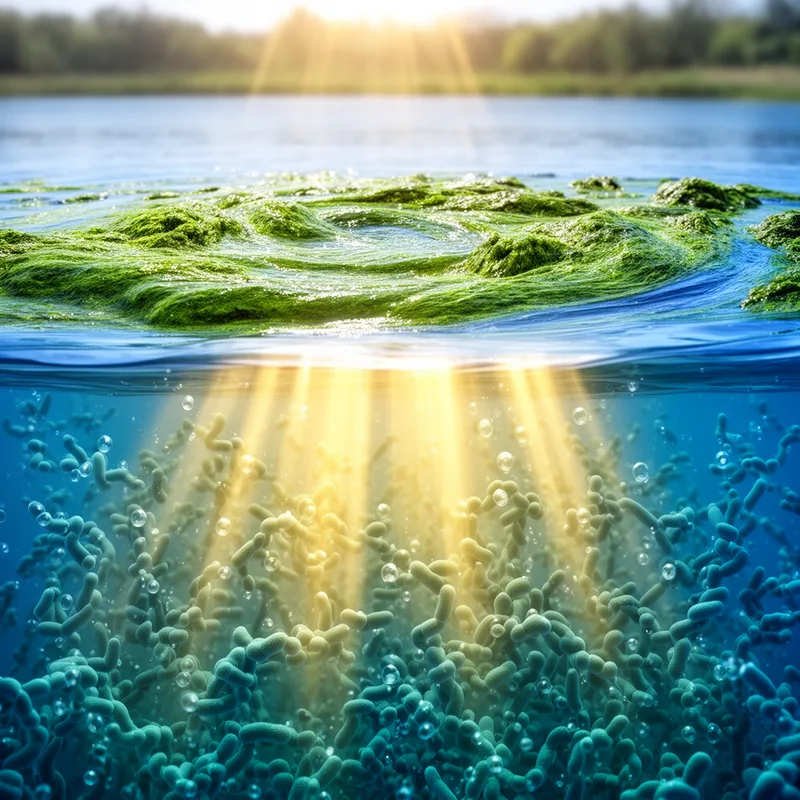
cyanobacterial


 1
9.2
- adjective
- /ˌsaɪənoʊˈbæktəriəl/
- Specialized
- The cyanobacterial blooms in the lake can produce harmful toxins that affect fish and humans.
- cyanobacterial mats
- cyanobacterial clock
Examples
-
It's almost like cyanobacterial soup that when they step down, you can see squished cyanobacterial sort of footprints there.
-
In this article, we discuss the dynamic interactions between cyanobacterial mats in the dry valley streams and the physical and geochemical processes of the stream ecosystems.
Academic text (1999) -
The real significance of the cyanobacterial transcription loop isn't the only mystery.
Academic text (2005) -
Long-term persistence of cyanobacterial mats.
Academic text (1999) -
Hurlburt is also planning on using a genetic approach to "knock out" genes in cyanobacterial species involved in off-flavor compound production.
Academic text (2003) -
"And that makes the cyanobacterial clock pretty different from the animal clocks, the fungal clocks, and presumably the Arabidopsis or the plant clock."
Academic text (2005) -
The cyanobacterial clock almost certainly evolved separately from the eukaryotic clock, says geneticist Steve Kay of the Scripps Research Institute.
Academic text (2005) -
Thus, we propose that these stone pavements are an important physical legacy from past summers that promote the current growth of cyanobacterial mats and shape the ecological system.
Academic text (1999) -
The cyanobacterial mats in dry valley streams are essentially perennial, growing at a slow rate during the summer flow period and overwintering in a freeze-dried state.
Academic text (1999) -
The cyanobacterial molecular clock in the species Synechococcus elongatus has been shown to contain three central genes, called kaiA, kaiB, and kaiC (after the Japanese word for "cycle").
Academic text (2005)
Synonyms
Relating to blue-green bacteria that make food from sunlight
Surface Forms
Morphology
cyanobacterial = cyanobacteria (semi-transparent) = cyano + bacteria + al
This is a regular adjectival formation from the technical noun 'cyanobacteria', but the base term itself is specialized and may not be familiar to many learners.
Etymology
Cyanobacterial begins with cyano-, the same root as the color cyan, which means 'blue', and ends with bacteria, meaning 'small living things'. So cyanobacterial means 'blue-green bacteria', bacteria that use sunlight to make food, which explains why the word describes blooms or contamination caused by these organisms.