
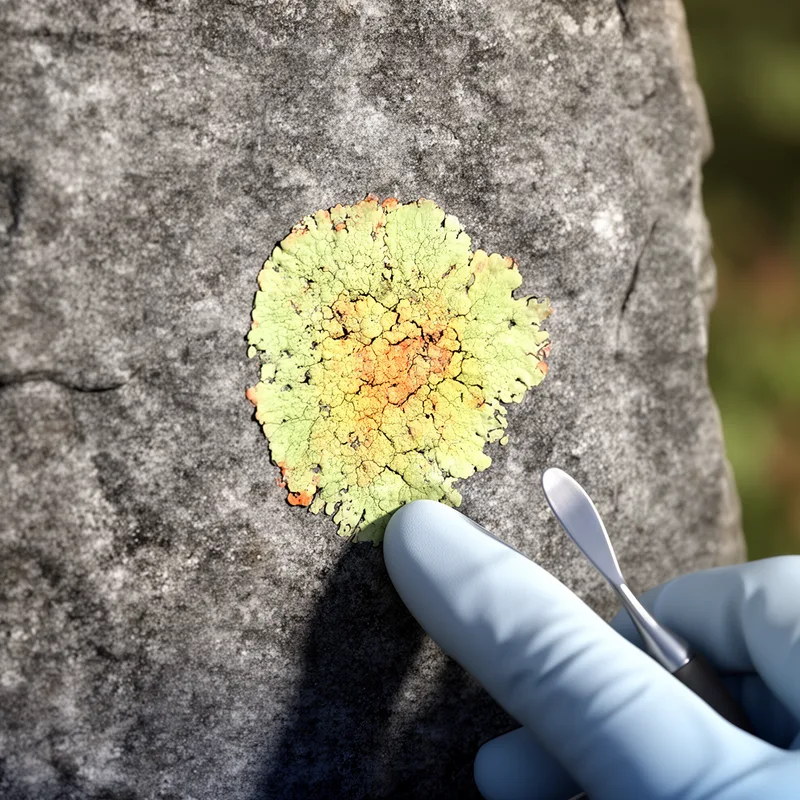
crustose thallus
- noun
- /ˈkrʌstoʊs ˈθæləs/
- Specialized
- The crustose thallus of the lichen formed a hard layer on the tree bark, providing protection from the elements.
Examples
-
Many lichens produce a simple crustose thallus intimately attached to the substratum, as do certain species of red and brown marine algae (Figure 5).
Academic text (2001) -
In ecology class, we learned that a crustose thallus can indicate the health of ecosystem due to its sensitivity to pollution.
-
Scientist studied the crustose thallus found on the rocks, noting how well it blended with its environment.
Surface Forms
Morphology
The compound is fully compositional: 'crustose' means 'forming a crust-like layer' and 'thallus' means 'a plant/lichen body', so the phrase literally denotes a crust-like lichen body. Although somewhat technical, the meaning follows directly from the constituent meanings and would be derivable by a learner who knows both words.
Etymology
Crustose thallus comes from the words crustose, meaning 'like a crust', and thallus, meaning 'the body of a lichen'. Picture a thin crust glued flat to a rock or tree so it cannot be easily lifted. That's why the term means 'a thin, crust-like lichen body that sticks closely to the surface'.

