

crustal plate
- noun
- /ˈkrʌstl pleɪt/
- Specialized
- The collision of two crustal plates can lead to the formation of mountain ranges.
Examples
-
The movement of the crustal plate created a powerful earthquake in the region.
-
Scientists study how crustal plates interact to understand volcanic activity better.
-
The crustal plate shifted ponderously about.
Fiction book (1992) -
Pressure cooks much of it into sandstone, as one crustal plate slides over another like a hand.
Academic text (1998) -
Plus or minus the couple of millimeters a year that the crustal plates grind along.
Fiction book (1995) -
Geophysicists measuring the relative velocity of crustal plates along the San Andreas Fault need positions down to a few millimeters or better.
Academic text (1996) -
Most of the planet's volcanoes smoldered where the edges of great crustal plates met gratingly or rode up over each other, as along this great ocean's famous Ring of Fire.
Fiction book (1990)
Synonyms

 296
3.4
296
3.4

A flat thin piece of material like metal or bone
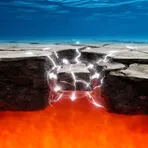
A small part of the Earth's outer layer that moves on its own
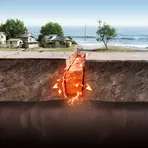
A small part of Earth's crust under a larger plate that can cause local earthquakes
How Large

Surface Forms
Morphology
The meaning is directly compositional: 'crustal' relates to the Earth's crust and 'plate' denotes a sheet or slab, so a B1 learner who knows both constituents can infer 'a sheet/segment of the crust.' Although the term is technical (geological), the parts combine in a transparent, predictable way that maps onto common language patterns for naming parts of the Earth.
Etymology
The noun crustal plate comes from a simple picture: the Earth's outer crust is like a hard shell that breaks into large, flat plates, like big dinner plates floating on softer rock below. That's why crustal plate means a large, hard part of the Earth's outer layer that slowly 'moves' and causes earthquakes where plates meet.