

to cross swords
 5
6.8
5
6.8

- idiom
- Informal
- You should be careful not to cross swords with your colleagues at work; it can lead to unnecessary conflicts.
- going to cross swords
Examples
-
My apologies to those I have crossed swords with here on RD's blog.
Blog text (21) -
Inevitably, the working relationship between father and son soon disintegrated as the son with the medical education constantly crossed swords with the father who had no formal qualifications.
Academic text (2010) -
I doubt I will bother crossing swords, as you say, with you again.
Blog text (6) -
Oh perhaps you'd like to cross swords with me some time.
-
I should like very much to cross swords with real buccaneers.
-
That'll teach you to cross swords with the Thief Lord.
-
Make the Kaiser rue the day he dared to cross swords with us.
-
He crossed swords in his letters with religious friends and colleagues, albeit in a cordial manner.
Academic text (2001) -
True, Pete still had to cross swords with Jane Palmer from time to time, but the mess had never put a dent in the group's popularity.
Fiction book (1990) -
Since Svensmark posted his approved translation here on WUWT, he must be aware of Leif's persistent criticism of his theory, and it would be appreciated by everybody if he and Leif crossed swords at this forum.
Blog text (30)
Synonyms
 ∞
1.0
∞
1.0
To take part in a physical or verbal struggle against someone
 607
1.1
607
1.1
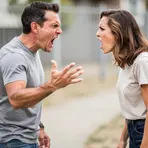
To speak angrily with someone because you disagree
 119
7.5
119
7.5
Argue angrily with someone about something
 46
3.1
46
3.1
To disagree strongly with another person or group
 36
2.9
36
2.9
To talk with someone because you disagree about something
 25
4.9
25
4.9
To have a short, unimportant argument with someone
 13
6.3
13
6.3
To argue strongly with each other
 5
5.1
5
5.1
To argue strongly with someone about something
 5
7.1
5
7.1
To argue in a friendly, quick way without serious anger
 3
7.3
3
7.3
To take part in a fight or argument
 3
7.5
3
7.5
To argue directly with someone in public or in a debate
 2
2.8
2
2.8
Argue with someone and feel angry or upset afterward

To argue angrily, often for a long time or in public

To argue strongly in public, often in writing or speech

Argue a little about something, like where to eat
Antonyms

How Intense

Surface Forms
Morphology
cross + swords
The constituents ('cross' meaning to oppose/frustrate and 'swords' as weapons) clearly evoke confrontation, so a learner who knows both words can infer a sense of conflict or fighting. However, the use of that literal combat image to mean a verbal dispute is a metaphorical extension rather than a strictly compositional meaning, so it is partially but not fully predictable without prior exposure.
Etymology
Cross swords comes from the picture of two people in a real fight who literally cross their swords when they meet. That image of a direct fight was used for strong arguments, so now cross swords means 'to argue' or 'to have a conflict'.