

to cross oneself
 1
6.5
1
6.5

- phrasal verb
- The old women in the village crossed themselves and whispered crazy things, said strange things, "el diablo cazador de hombres".
Examples
-
In Italy, when a coffin passes by, people cross themselves.
-
the antlers that you like to wear, before you cross yourself and lift his head.
-
You could cross yourself and you could live to tell the story, though you didn't deserve to.
Fiction book (1990) -
Well,... you are supposed to sit on your luggage and sigh a little and cross yourself.
-
lt's all the devil's work, and you'd better cross yourself quick before he gets you.
-
You crossed yourself?
Fiction book (1995) -
I brought you to the kitchen, and you stayed in the doorway, taking it all in, and when you saw... when you saw Teddy, you crossed yourself. "No, ma'am?"
Fiction book (1995) -
When the shadows of night creep over their gloomy hills, and the hungry dogs howl in the moonlight, the peasants cross themselves and hide in their huts.
-
Before the ceremony began, the congregation quietly crossed themselves in reverence.
-
As he entered the church, he paused to cross himself at the entrance.
Synonyms
 28
8.1
28
8.1
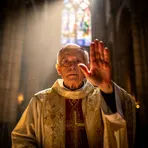
To make the cross with your hand as a religious blessing
Surface Forms
Morphology
The meaning 'to make the sign of the cross on the body' is directly derivable from combining 'cross' (the Christian symbol) with the reflexive 'oneself' (apply to one's own body): it literally means to mark oneself with a cross. This reflexive construction and the ritual action are cross-linguistically common and follow regular English composition, so a B1 learner who knows the constituents should be able to infer the meaning.
Etymology
The verb cross oneself comes from the simple action of using the hand to draw a small cross on oneself, usually on the forehead, chest and shoulders, as a quick prayer or to ask for protection. So, the phrase means 'to make the sign of the cross' as a religious act.