
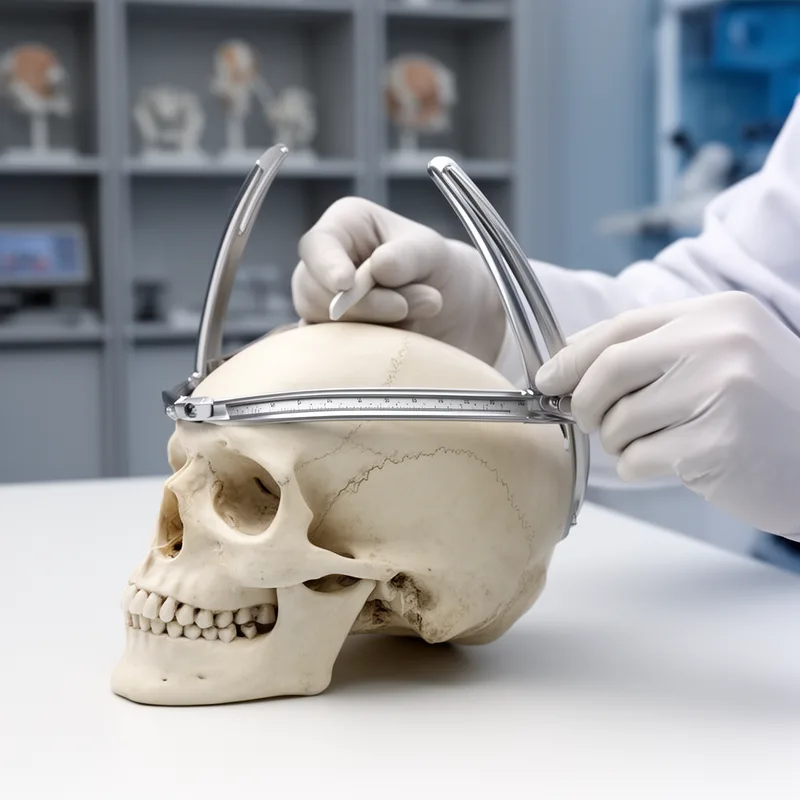
craniometer
- noun
- /ˌkreɪniˈɑːmɪtər/
- Specialized
- A craniometer is essential for accurately measuring cranial capacity in forensic studies.
Examples
-
The doctor used a craniometer to assess the patient's skull size.
-
The anthropologist used a craniometer to gather data about the ancient skulls.
-
With the help of a craniometer, scientists compared the skulls of different primate species.
-
Many craniometers are designed for precise measurements.
-
A craniometer is essential for accurately measuring cranial capacity in forensic studies.
-
The anthropologist used a craniometer to gather data about the ancient skulls.
-
With the help of a craniometer, scientists compared the skulls of different primate species.
Surface Forms
Morphology
Etymology
The word craniometer comes from Greek parts crani- meaning 'skull', as in cranium, and -meter meaning 'measure', as in thermometer. So a craniometer is a tool to 'measure' the skull, which explains its use in studying skull size and shape.

