

craniology
- noun
- /ˌkreɪniˈɑlədʒi/
- Archaic
 :
craniología
:
craniología
- Research in craniology has revealed significant differences in skull structures across populations.
Examples
-
Gerasimov specialists, who tend to have a background in anatomy, osteology, or craniology, first examine the skull to check for any unusual signs or markings.
Academic text (2003) -
The new orientation emerged in the context of the rising interest in phrenology and craniology, new attitudes regarding the body, and the debate over the incorporation of the Indian into American society.
Academic text (1996) -
The Austrian Institute of Craniology has asked many times for you to lecture there on your theory of brain transplants.
-
The study of craniology focuses on the variations in skull shape among different races.
-
To understand human evolution better, scholars often delve into craniology and its findings about ancient skulls.
Synonyms


 1
9.9
1
9.9
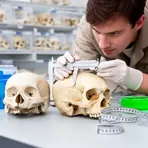
Measuring skulls to learn about people or animals
Surface Forms
Morphology
craniology = cranio + logy
This is a learned classical formation meaning 'skull study' from cranio- and -logy, so the structure is clear but the term is technical.
Etymology
Craniology comes from the Greek root crani- meaning 'skull' and the ending -ology meaning 'study of'. So, craniology literally means the 'study of skulls', and in the nineteenth century people used it to measure skull size and shape to compare different races.