
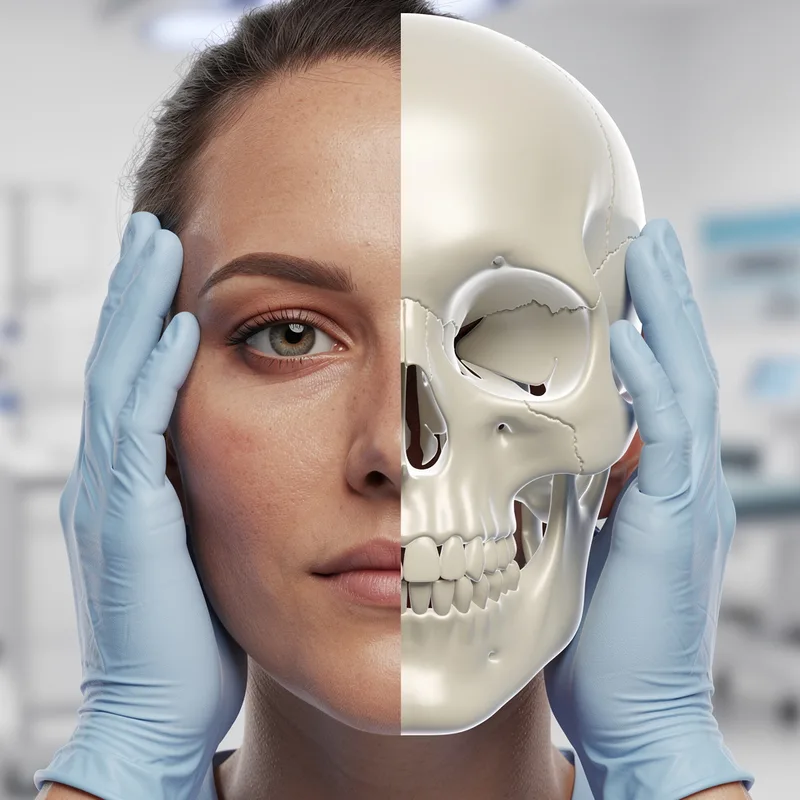
craniofacial
 1
7.2

- adjective
- /ˌkreɪniəˈfeɪʃəl/
- Specialized
- The phenotype is extremely variable, and its clinical characteristics include a combination of craniofacial, cardiac, renal, gastrointestinal, and genitourinary defects.
- craniofacial resection
- craniofacial bones
- craniofacial deformities
Loading YouTube…
Watch on YouTubeSo if this trend continued, if this craniofacial feminization trend continued, what would the male, what would all of our skulls look like?
- So if this trend continued, if this craniofacial feminization trend continued, what would the male, what would all of our skulls look like?
- But at rest we should nasal breathe is the argument and that greatly improves craniofacial aesthetics.
Examples
-
Single-suture craniosynostosis (SSC) is a common craniofacial condition with potential neurocognitive sequelae.
Academic text (2015) -
The project described was supported by the National Institute of Dental and Craniofacial Research Grant R56DE018004.
Academic text (2012) -
No patient in this series had experienced a developmental delay or craniofacial syndrome.
Academic text (2008) -
Historical reviews of pneumocephalus show that 75% of cases occur after craniofacial surgery and trauma.
Academic text (2008) -
Patients with CL/P and an underlying syndrome or other craniofacial diagnosis were excluded.
Academic text (2015) -
After radiotherapy had failed to arrest the tumor's growth, the mass was removed via a craniofacial resection.
Academic text (2001) -
The incidence of craniofacial manifestations of fibrous dysplasia ranges between 10% and 32%.
Academic text (2006) -
Makers of rapid prototyping technology are using CT scans to create exact-fit implants for craniofacial and maxillofacial operations.
Academic text (2010) -
The patient was treated with intensity-modulated radiation therapy concomitant with chemotherapy, followed by craniofacial resection and free-tissue graft reconstruction.
Academic text (2009) -
The team of doctors specializes in craniofacial surgery to correct facial deformities and improve patients' appearance.
Surface Forms
Morphology
Etymology
The word craniofacial joins two parts: cranio- (from cranium, 'skull') and facial (from face, 'face'). So craniofacial describes things that belong to both the skull and the face.