
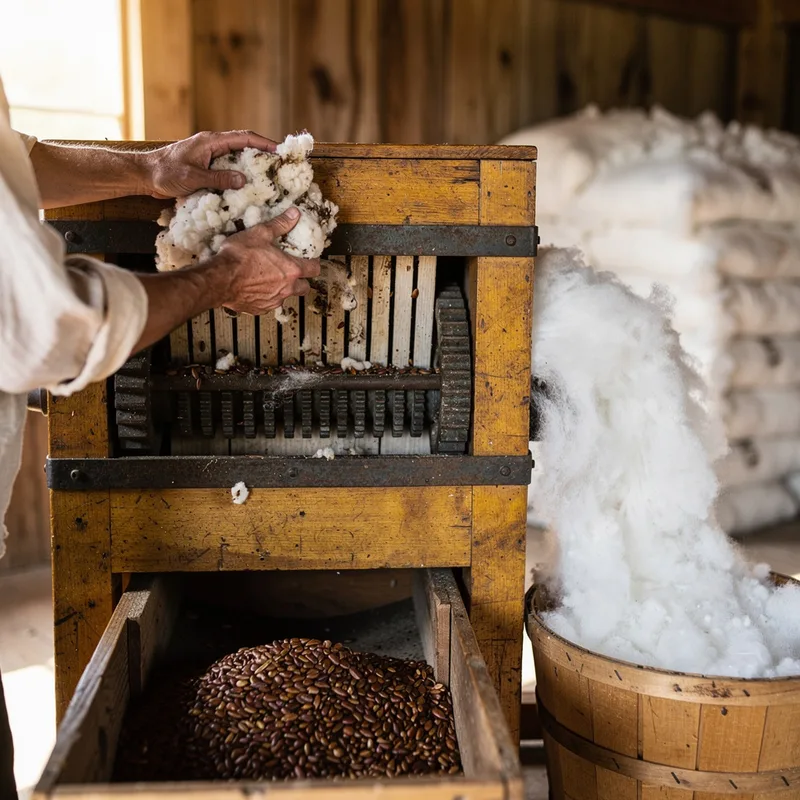
cotton gin
 4
3.6
4
3.6

- noun
- /ˈkɑtən dʒɪn/
- Specialized
- The corrugated roofs of a cotton gin and a farm equipment yard glitter above the cramped houses that huddle in their treeless yards.
- the invention of the cotton gin
- work at a cotton gin
- operated the cotton gin
Examples
-
Worked in a cotton gin.
-
The cotton gin significantly increased the efficiency of separating seeds from raw cotton fibers.
-
Brought more business to town than anything since the cotton gin.
-
The cotton gin might be history's best example of that.
Academic text (2009) -
Production increased by a staggering amount with the introduction of the cotton gin.
Academic text (2009) -
In 1793, the cotton gin was invented.
-
It contained a cotton gin, two lumber yards, a bank, and several other businesses.
Academic text (1990) -
He has a job on Saturdays over at Andy's cotton gin.
-
Two days later, I drove down to Sidon, a tiny town consisting of a few houses, a convenience store, a water tower, a cotton gin, a grain elevator, and Southwest Leflore County High School.
Fiction book (1997) -
In 1793—the year Eli Whitney invented the saw cotton gin—the U.S. exported 487,600 pounds of cotton.
Academic text (2011)
Synonyms

Surface Forms
Morphology
The meaning 'a machine used to separate seeds from raw cotton fibers' is directly and compositionally derived from 'cotton' (the raw fiber) + 'gin' (a machine for removing seeds), so a learner who knows both words can infer the compound's function. Noun–noun compounding of this type is common cross-linguistically (e.g. 'coffee grinder', 'rice mill') and follows a straightforward compositional pattern, making it transparent to B1 learners.
Etymology
Cotton gin comes from the old short word gin, which meant 'machine' or 'engine', and it named a machine that pulls the seeds out of fluffy cotton. That's why today cotton gin means 'a machine that separates seeds from cotton'.