
costal cartilage


 1
5.8
1
5.8
- noun
- /ˈkɔstəl ˈkɑrtɪˌlɪdʒ/
- Specialized
- Costal cartilage, although frequently used for total auricular reconstruction (24), is thicker and requires precise cutting, and is not suitable for one-stage grafting (20).
- costal cartilage graft
- autologous costal cartilage
- reconstruction using costal cartilage
Examples
-
The helical rimhelix unit and crus helicis are constructed using the eighth costal cartilage.
Academic text (2014) -
In the first stage, the lobule is split and transposed, and a three-dimensional (3D) costal cartilage framework is constructed and inserted in a subcutaneous pocket.
Academic text (2014) -
The sixth and seventh costal cartilages are used to construct the base frame.
Academic text (2014) -
The use of autogenous costal cartilage has been shown in several different studies to be efficacious.
Academic text (1995) -
The ninth costal cartilage forms the antihelix, superior and inferior crus.
Academic text (2014) -
Despite the advances in other methods, autologous costal cartilage graft remains the mainstream of ear reconstruction surgery.
Academic text (2014) -
First stage: Nagata harvests the ipsilateral sixth to ninth costal cartilages to fabricate the framework.
Academic text (2014) -
A total of 96 microtia patients, ranging in age from six to 26 years, underwent reconstruction using autogenous costal cartilage between 2007 and 2010.
Academic text (2012) -
Until that time, the stenoses were generally anterior and surgically corrected with an anterior costal cartilage graft.
Academic text (1995) -
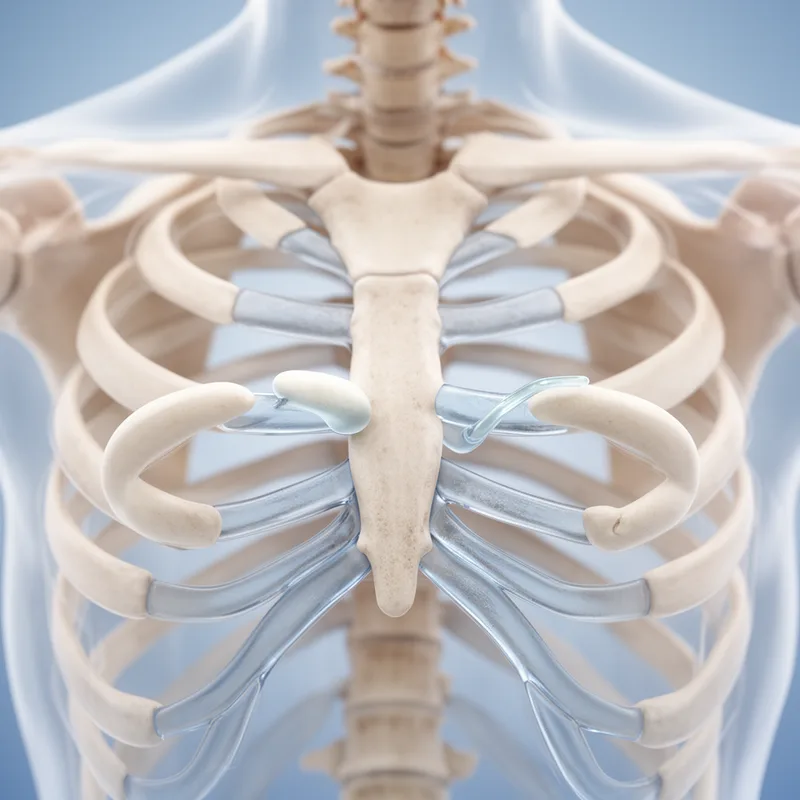
The costal cartilage connects the ribs to the sternum, allowing for flexible movement of the chest during breathing.
Surface Forms
Morphology
The term is directly compositional: 'costal' means 'pertaining to the ribs' and 'cartilage' is a flexible connective tissue, so a learner who knows both constituents can infer it is the cartilage associated with the ribs. Anatomical compound nouns like this follow regular naming patterns (common across languages), making the specific function and location of the structure predictable from its parts.
Etymology
Costal cartilage is the name for the soft, bendy tissue that joins each rib to the breastbone. The word costal comes from an old word for 'rib' and cartilage means soft tissue, so the name is a clear image of the 'rib cartilage' that lets the chest move when we breathe.