

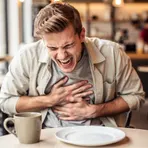
to convulse with laughter
- phrasal verb
- /kənˈvəlz wɪð ˈlæftər/
Examples
-
Tommy and Booker convulsed with laughter.
Academic text (2008) -
"No judge in this town!" She let the elastic go, fell back so she was half-lying on the bench, and convulsed with laughter, clutching her bare midriff.
Fiction book (1997) -
Tommy and Booker convulsed with laughter after hearing the hilarious joke.
-
We convulsed with laughter when the comedian fell off the stage in the middle of his act.
-
The children convulsed with laughter as they watched the funny movie together.
Synonyms

 18
3.5
18
3.5

To laugh loudly and without control
 15
3.4
15
3.4
Laugh loudly and without control
 9
3.0
9
3.0
Start laughing very hard and cannot stop
 8
7.8
8
7.8
Shake hard and without control because of illness, a strong feeling, or a hit
 8
2.4
8
2.4
To suddenly start laughing loudly and not be able to stop
 3
5.1
3
5.1
To make loud, long sounds because something is very funny
 1
8.6
1
8.6
To laugh loudly in a silly, noisy way


 1
3.5
1
3.5
To make loud sounds you cannot stop because something is very funny
 1
9.7
1
9.7
To laugh very hard at something funny online
 1
5.6
1
5.6
To laugh very hard

Feel so amused that you fall over and move on the floor

To laugh so hard you almost choke

To laugh very hard, often at something funny online

Laugh loudly and deeply, making your stomach move

To laugh loudly and without control

To laugh loudly because something is very funny
Antonyms

How Hard
 17
2.4
10
2.5
∞
1.0
237
2.0
153
1.0
17
2.4
10
2.5
∞
1.0
237
2.0
153
1.0
Surface Forms
Morphology
The meaning is directly compositional: 'convulse' = shake violently, combined with 'with laughter' clearly describes shaking caused by laughing. This literal cause-effect construction is cross-linguistically common, so a B1 learner who knows the constituent words should be able to infer the MWE's meaning.
Etymology
Convulse with laughter gives a clear picture: the word convulse means to shake or jerk and laughter is what happens when you laugh. So, the phrase means 'to laugh so hard that your body shakes uncontrollably'.