
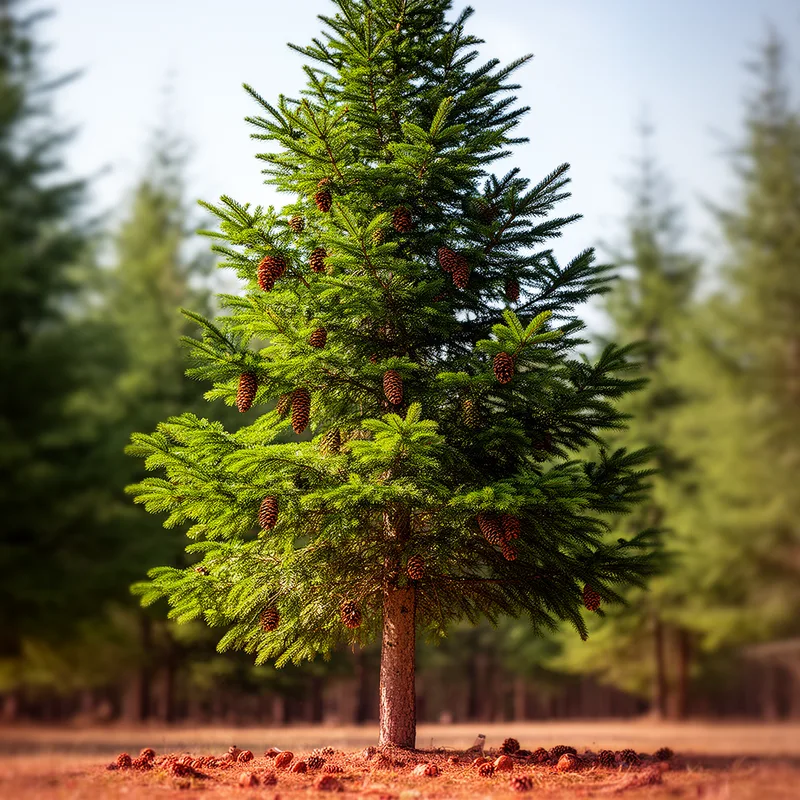
coniferous tree
 1
3.9
1
3.9

- noun
- /ˌkɒnɪˈfərəs tri/
- Beginning in the eighteenth century, the forest was largely cleared to plant crops; two centuries later, that same mixed hardwood and coniferous tree cover had recolonized the fallow land of abandoned hill farms.
Examples
-
This great forested landscape is filled with towering coniferous trees like pines and spruces.
-
Some say the beavers would threaten the logging industry, which is dependent on coniferous trees.
Academic text (2001) -
He wanted to control the non-forest vegetation on his land so that he could plant valuable coniferous trees to sell for lumber and Christmas trees.
Academic text (1992) -
Acid soils also occur most frequently in higher precipitation areas, especially in areas where coniferous tree cover was and continues to be the dominant type of vegetation.
Blog text (12) -
Black spruce, jack pine, and other coniferous trees - hallmarks of the Boreal - are moving north, with aspens and birches filling in behind.
Academic text (2012) -
A fire history study in the northern range of Yellowstone noted scars on coniferous trees near aspen approximately every 50 years for the last 350 years (Houston 1973).
Academic text (2002) -
Except in riparian zones, a closed canopy of mixed coniferous trees is the general cover condition of primary forest stands within the PNW region (Franklin and Dyrness 1988).
Academic text (1996) -
A lot of coniferous trees grow in the taiga.
-
Animals often seek shelter in coniferous trees due to their thick foliage.
Synonyms
 6
4.6
6
4.6
A tree like a pine or fir that makes cones and usually has needles
Surface Forms
Morphology
The meaning 'a tree that bears cones and is typically evergreen' is directly derivable from combining 'coniferous' (bearing cones/evergreen) with 'tree' (a tall perennial plant). This adjective+noun composition is a standard, compositional pattern with clear cross-linguistic equivalents, so a B1 learner who knows both constituents will understand it.
Etymology
Coniferous tree comes from an old word conifer, which combines the ideas 'cone' and 'to carry', so imagine a tree that 'carries' cones on its branches like little seed boxes. That's why 'coniferous tree' means a tree that makes cones and often has needle-like or scale-like leaves.