

computer memory
 3
2.8
3
2.8

- noun
- /kəmˈpjuːtər ˈmɛməri/
- Specialized
- Everything they say is broken down and stored... ...in the computer memory banks.
Loading YouTube…
Watch on YouTubeSo he uses the analogy of computer memory.
- So he uses the analogy of computer memory.
Examples
-
SiteShoter now uses the computer memory instead of the video card memory.
Blog text (7) -
The first thing the table tells us is that high resolutions take a long time to load and process if computer memory is limited.
Academic text (1994) -
Some of them are quite simple and require a minimum of computer memory; some are complex programs with many features and require a lot of memory.
Academic text (1993) -
As computer memory becomes cheaper, more and more of these electronic footprints are being saved.
Blog text (32) -
Computer memory can, of course, be increased, but the going rate for RAM at this time is about $50 to $60/MB.
Academic text (1994) -
Therefore, this method results in increased complexity of the FE model and requires additional computer memory due to the increase in the number of degrees of freedom per element.
Academic text (1996) -
The votes (electronic forms) sit in computer memory until a resident program operates on them to produce the usual summaries.
Academic text (1998) -
In the past, this and other interactive VR websites have been fairly low-tech, but as computer memory prices fall and processor speed increases, VR interfaces on the Web are proliferating rapidly, and the quality of the sites is improving.
Academic text (1997) -
I upgraded my laptop with additional computer memory to improve its performance.
-
To run the application smoothly, ensure your computer memory is sufficient.
Synonyms
 157
4.4
157
4.4
A part of a computer that stores data
 27
3.5
27
3.5
Computer memory that stores data for a short time while the computer is on
 3
3.6
3
3.6
An electronic part inside a computer that stores data like RAM
 1
3.5
1
3.5
A thing that stores information like files or photos so you can use it later

 1
4.8
1
4.8
A small, fast part of a computer that stores often used data to make access quicker
 1
4.2
1
4.2
The computer uses part of its hard disk as extra memory when RAM is full
A part of a computer that stores data for a short time while it runs
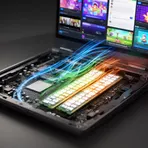
A part of a computer that stores data for a short time the system can read and change while running
How Much

Surface Forms
Morphology
The meaning is directly compositional: combining 'computer' (electronic processing device) with 'memory' (data storage) yields the idea of the storage associated with a computer. This follows a common noun–noun compounding pattern found across languages and uses high-frequency, literal constituents, so a B1 learner who knows both words should understand the MWE.
Etymology
Computer memory comes from comparing a computer to a person; long before machines, memory meant a person's power to 'remember' things, so early makers called the parts that 'store' data the computer's memory.