

commuter train
 10
2.5
10
2.5

- noun
- /kəˈmjuːtər treɪn/
- My husband and 14-year-old took their bikes on the commuter train to get to the suburban rock gym outside of Boston.
- commuter train station
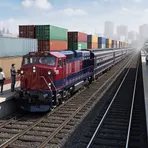
- passengers on a commuter train
- morning commuter train
Loading YouTube…
Watch on YouTubeThey want to not have to sweat on the commuter trains.
- They want to not have to sweat on the commuter trains.
Examples
-
A mob of passengers disembarks from a commuter train.
Fiction book (1990) -
The electric garage door opener is whirring as he and Henry round the corner toward the commuter train station.
Fiction book (1990) -
It's my first time on a commuter train.
-
-I met him on the commuter train.
-
I was on a New York City commuter train the other day, listening to a couple of teens talking.
Academic text (2009) -
I love seeing the Bay, the shorebirds, and yes, even the commuter trains that go by along the bay shoreline.
Blog text (3) -
We took Metro-North, which is a commuter train, but Amtrak would be easier (but more expensive).
Blog text (5) -
In Kyoto, I ride the efficient commuter trains and the safe, graffiti-free subways.
Academic text (1998) -
Outside his window, packed commuter trains crisscrossed a clogged freeway.
Fiction book (1996) -
Every morning, I take the commuter train to the city for work.
Synonyms
 ∞
1.0
∞
1.0
A long set of connected cars that carries people on rails
 8
1.5
8
1.5
A train that carries people, not goods
 1
1.8
1
1.8
A long line of connected cars that runs on tracks and carries people or goods
How Local

Surface Forms
Morphology
The meaning is directly and compositionally derived from 'commuter' (a person who travels regularly to work) + 'train' (a passenger rail vehicle); a B1 learner who knows both words can infer it is a train used by commuters. This noun–noun compound follows a common, cross-linguistic pattern for naming vehicles or services for a particular user group, so the sense is immediately predictable without prior exposure.
Etymology
Commuter train comes from the idea of a commuter, a person who travels regularly between home and work, and a train that carries many people. Imagine the same crowd boarding the same morning train from the suburbs to the city each day. That's why the phrase means a train used mainly by people 'traveling regularly between home and work or school'.