
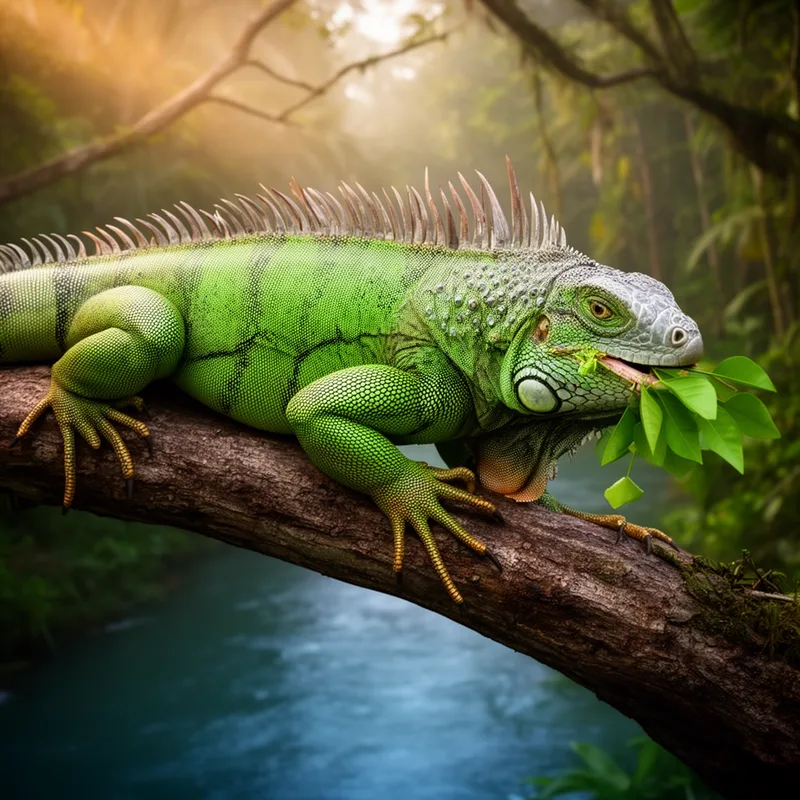
common iguana
- noun
- /ˈkɑːmən ɪˈɡwɑːnə/
- US
- The common iguana is often seen basking on tree branches near rivers in Central America.
Examples
-
The vivid green color helps young common iguanas blend in with the rainforest foliage.
-
Local farmers sometimes catch the common iguana for food.
-
The common iguana is often seen basking in the sun.
-
A common iguana can grow up to six feet long.
-
Local farmers sometimes catch the common iguana for food.
-
The common iguana is often seen basking on tree branches near rivers in Central America.
-
The vivid green color helps young common iguanas blend in with the rainforest foliage.
Synonyms

 2
3.9
2
3.9

A large lizard with a row of spines on its back that often lives in trees and eats plants

A large green lizard from Central and South America that lives in trees and eats leaves
Surface Forms
Morphology
The phrase is a simple adjective + noun combination where 'common' (frequent, typical) modifies 'iguana' (a large tree-dwelling lizard), so the meaning 'an iguana that is widespread or typical' is directly derivable from the parts. This compositional, cross-linguistically common structure makes the MWE immediately comprehensible to a B1 learner who knows both constituent words.
Etymology
Common iguana comes from a local word 'iwana' for the iguana and the English word common, which means 'seen a lot'. So common iguana simply names the familiar green lizard people often see in trees and sometimes use as food.